Most houses need one railing. A large custom home can need four: the main stair, the turn at the landing, the open gallery above the entry, and a deck out the back. Built one at a time by different trades they never quite match. Built as one set of tempered panels, same height, same mounting, same hardware finish, the railing reads as part of the house instead of an add on.
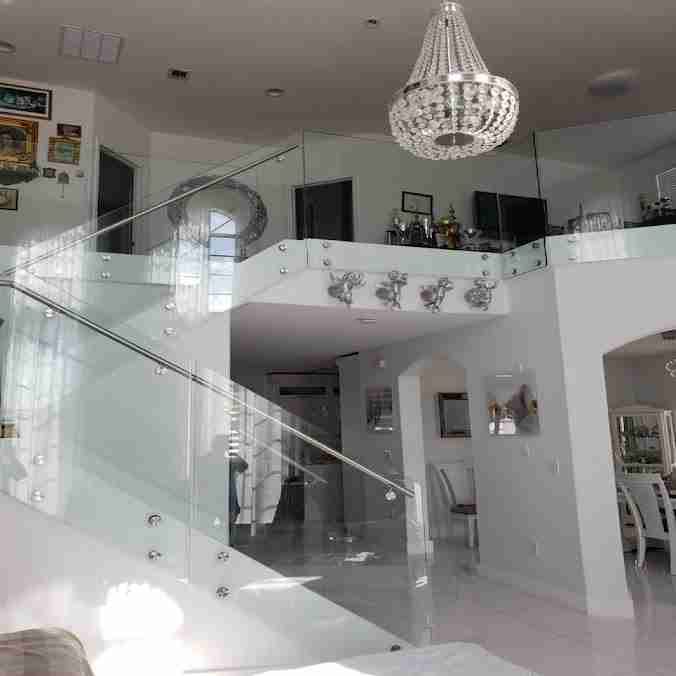
There are two ways glass goes up a staircase. Raked panels are cut on the same angle as the stringer, so the top edge runs parallel to the treads in one clean diagonal. Stepped panels stay rectangular and climb the flight in a series of squared off jumps. Raked looks quieter and is what most people mean when they picture a glass stair rail, and it asks more of the shop, because every panel is a different quadrilateral. Stepped has its own logic, especially against a stringer that is not perfectly straight, and it is more forgiving of a stair that was framed by eye.
Then the top edge. A polished bare edge is the frameless look and keeps a long diagonal as clean as it gets. A cap rail is a metal profile laid along the top: it stiffens a long run, ties panels together across a turn, and gives you something to actually put a hand on, which matters on a tall flight more than it does on a landing. On a stair that turns at a landing and continues, the landing is where the two decisions meet, and it is the first thing we lay out. Guard height, the load it has to take and the gap at the bottom all come from code, and we verify them on site before the layout is released.
In a contemporary custom home the entry is usually open to the second floor, which means the guard around the upstairs hall is not a small piece of trim. It is a long horizontal run of glass you see from the front door, at eye level, with nothing behind it. Get the panel breaks wrong on that run and it is the thing you look at every time you come home. We lay it out with the stair below it, so the joints line up with something and the finish on the standoffs matches what is on the flight.
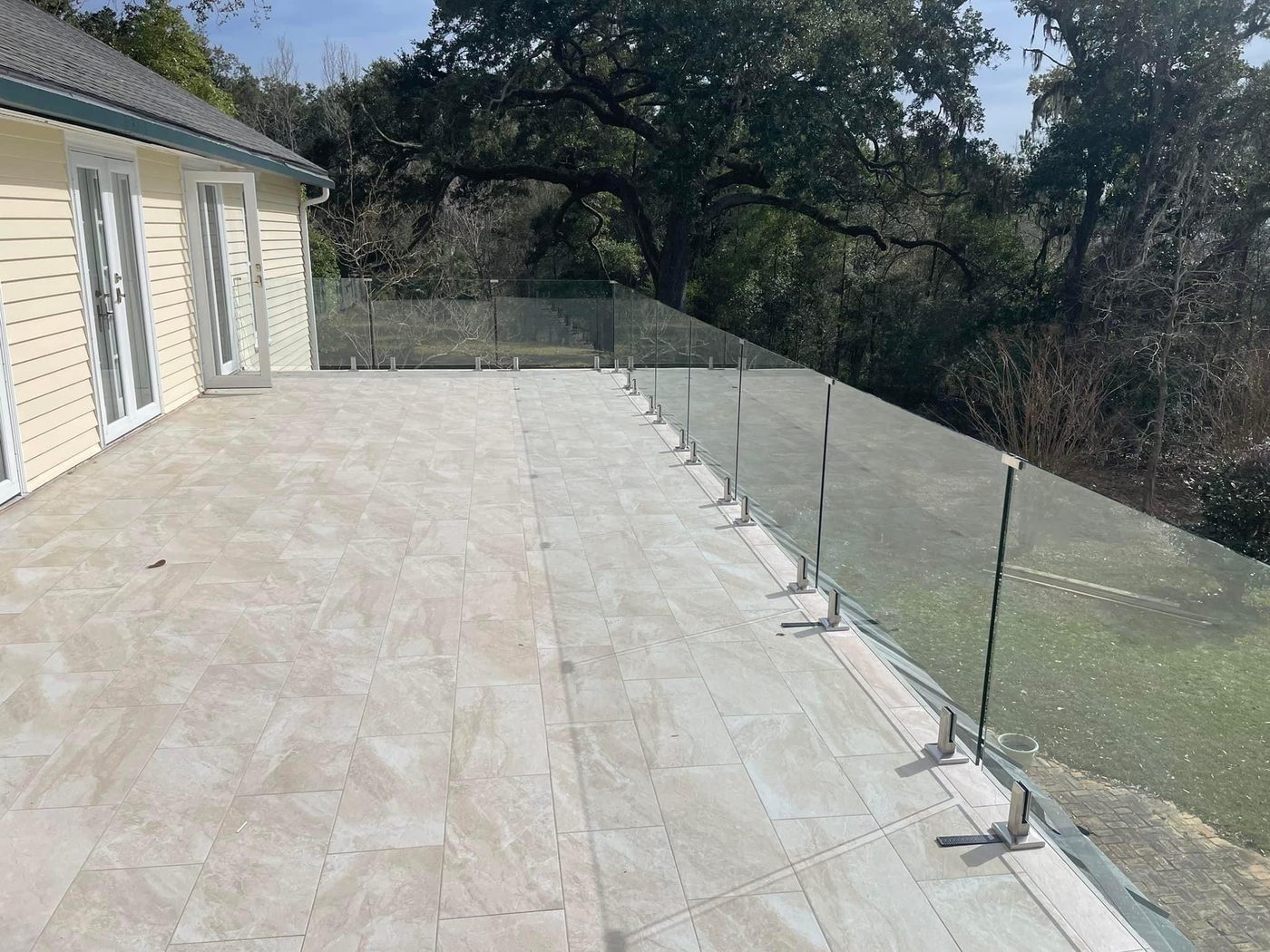
Outside, the same set of panels keeps going. Franklin Lakes lots are wooded and often multi acre, so a deck or a balcony is looking at trees rather than at a neighbor, and there is no reason to divide that up with pickets. The exterior work is not identical to the interior work: anchors go into structure that has to be sound after twenty winters, and hardware exposed to weather is specified differently than the same part on an interior flight. What stays the same is the panel height, the glass and the visual detail, so the deck rail and the gallery rail are recognizably the same railing.
More custom glass in Franklin Lakes: frameless shower doors, sliding & bypass shower doors, semi-frameless shower doors, shower door replacement, custom mirrors, custom glass shower enclosures, steam shower enclosures, bathtub shower doors, commercial glass. See everything on our Franklin Lakes, NJ page. Glass Railings nearby: Paramus, Ridgewood, Hackensack, Fort Lee, Lodi, Midland Park, Englewood, Teaneck, Fair Lawn, Mahwah, Wyckoff, Tenafly, Ramsey. Learn more about our glass railings across Bergen, Passaic and North Jersey, or read the Glass railings: code, cost & design in NJ and The NJ stair railing code breakdown guides.
Glass panels are flat, so a curve gets handled as a series of short straight sections that follow the arc, usually with a cap rail along the top to tie them together and smooth the line. On a gentle radius that reads very well. On a tight one it starts to look faceted, and we would rather show you that honestly at the measure than after fabrication. Every curve is its own layout problem.
Yes, and it is driven by glass size and handling more than by anything else. Panels have to be a size the shop can fabricate and a size two people can carry through your house and hold steady while it is anchored. Past that the run gets divided, and where it divides is a design decision as much as a practical one. We set the breaks at the survey so they land somewhere deliberate.
The structure has to be final and the surfaces it anchors to have to be the surfaces that are staying. Stair treads and stringers set, decking down, masonry capped, flooring in if the base shoe lands on it. Anchors go into structure, so if blocking needs adding between joists or a post has to be reset, that happens before we template. Holes are machined before the glass is tempered, and tempered glass cannot be drilled afterward.
Very little. Interior hardware is a wipe when you dust. Outdoors, once a year is worth it: look at the covers, check nothing has worked loose, rinse road salt or fertilizer off the metal in spring. The glass itself is the part that shows anything, and rain does most of that job on a deck rail. Under trees you will be squeegeeing pollen in May like everyone else in Bergen County.
Largely, yes, and it is the reason to plan the runs together. Panel height, glass and the mounting style can carry straight from the entry stair to the deck. What changes outdoors is what the hardware has to survive, so exterior anchors and fasteners get specified for weather even when they look identical from six feet away. Order the whole set at once and the finish matches, which is not as certain months apart.
Yes. Midland Park, 108 Greenwood Ave, about twelve minutes from Franklin Lakes and by appointment only. Finish samples are the point of the place, with glass and hardware alongside them: oil rubbed bronze, matte black, brushed nickel, polished chrome, held next to each other in real light, which is what you actually need, since a finish in a photograph tells you very little. Lodi, roughly twenty four minutes, takes walk-ins six days a week.
List the runs you know about and the ones you are thinking about, with a rough length for each. Someone comes out from Midland Park, about twelve minutes through Wyckoff, checks what each panel has to fasten to, and measures every run at no charge. Call (201) 507-5918.
List the runs you know about and the ones you are thinking about, with a rough length for each. Someone comes out from Midland Park, about twelve minutes through Wyckoff, checks what each panel has to fasten to, and measures every run at no charge. Call (201) 507-5918.
Text Jessica directly with photos. To speed things up, include: