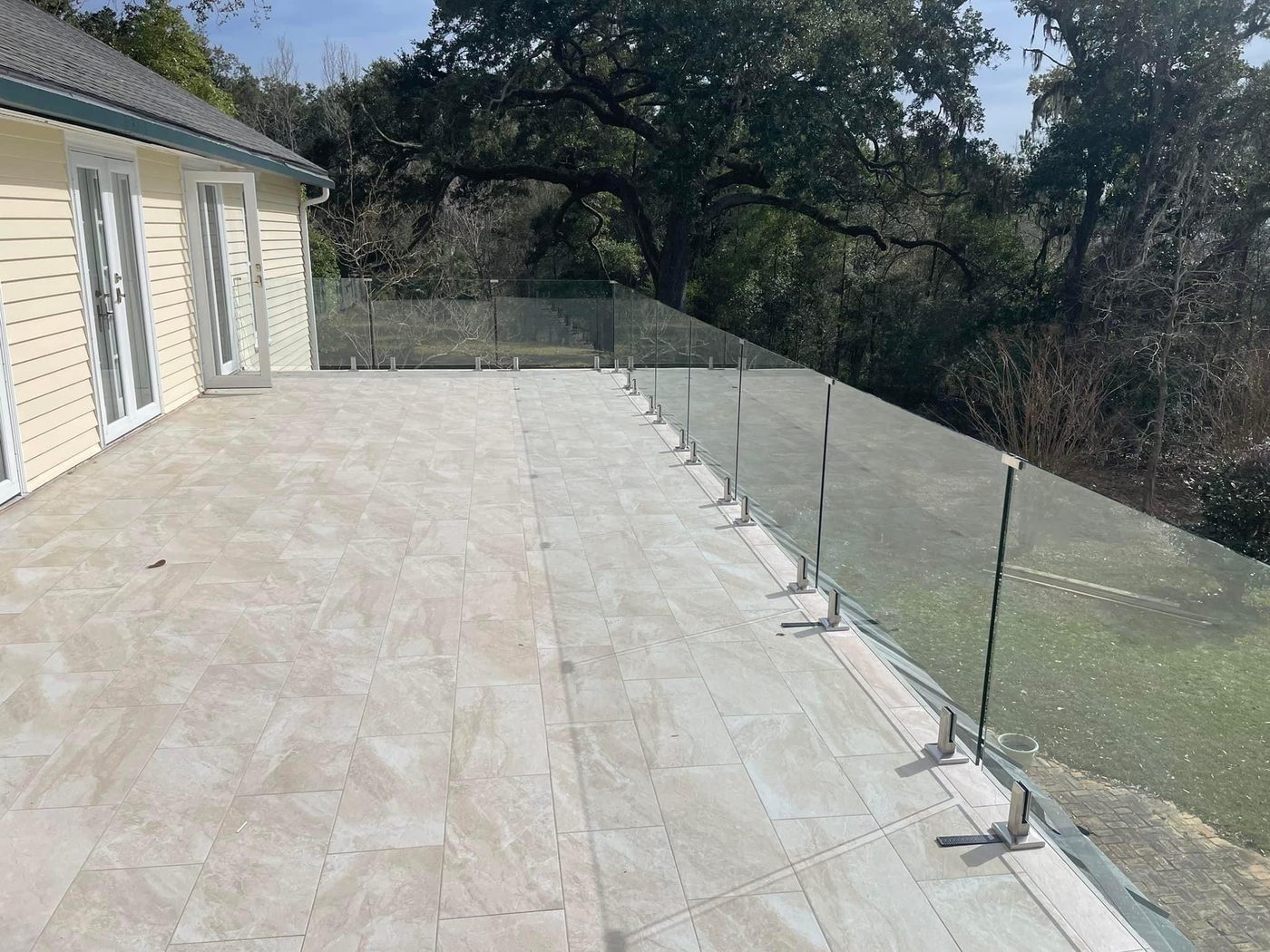
Nobody picks out a railing for its own sake. You pick it for what stays visible past it, and around here that is ridge, woods and a lot of sky. Glass is the only guard that hands all of it back while still doing the work: the height the code calls for, the load a guard has to resist, and the weather that comes with living outdoors year round. We make the panels frameless in tempered safety glass, pinned through standoffs or carried in a base shoe, for the stairs and landings inside a Mahwah house and the decks and balconies outside it. The panels are cut and finished at our Lodi shop, and our own crew hangs them. No charge to come out and measure the run.
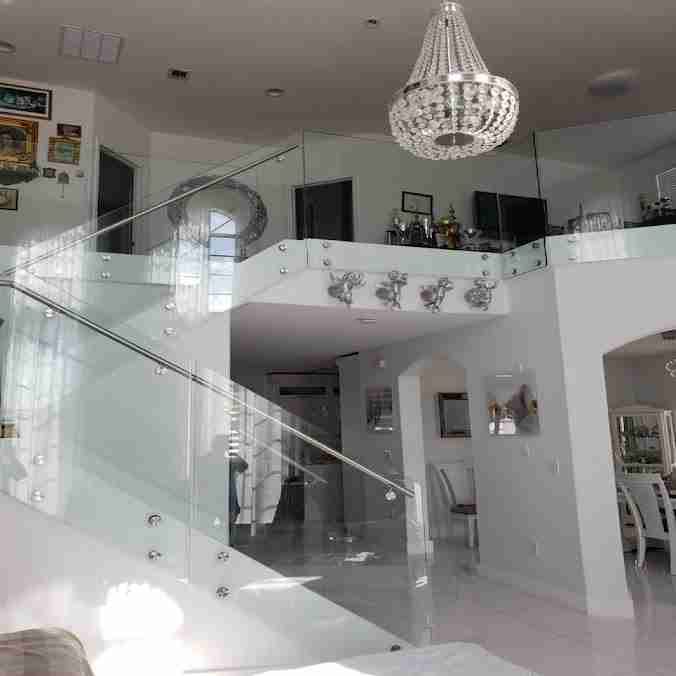
A railing job starts as arithmetic. We measure the total run, then work out how many panels it breaks into and where the joints land, because a joint in the wrong place reads as a mistake for as long as the rail exists. Stairs get their own treatment, since the top edge rakes with the nosings and the layout has to respect where a newel or the first standoff can physically go. Corners and returns need a planned gap rather than a hopeful one. Height is not a style choice: a guard has a required height and a load it has to resist, and both get confirmed at the measure before anything is ordered. Level runs and landings are simpler, but they still get laid out on paper first.
Then we find out what the panels are fastening to, which is the part nobody sees and the only part that can fail. Standoff hardware pins each panel through the face of a stringer, a rim joist, a wall or a masonry edge, so there has to be real structure behind the finish. A base shoe works the other way, gripping the glass along its whole bottom edge inside a channel that bolts down to the deck or the landing, which wants solid framing beneath it and a surface flat enough for the shoe to seat. At the measure we look at what is actually there instead of assuming, and if the substrate cannot take the anchors you will hear it before glass is cut. Panels are tempered safety glass, with hardware in polished chrome, brushed nickel, matte black or oil-rubbed bronze.
The reason people here ask for glass is usually the view. Mahwah runs up into the Ramapo Mountains, and the custom homes tucked into that side of the township look out at ridge and woods instead of at another roof. A wood or metal rail slices that into strips, and it does it worst exactly where you sit down. Glass keeps the whole thing, standing or seated. The lots do something else as well: they slope. A deck built off the back of a house on falling ground can sit well above the yard, and it often steps down in stages to get there. Each of those stages is a separate run with its own height, its own joints and its own anchoring.
Height above grade is what makes the guard serious, which is why we spend the measure on what sits under the decking rather than on the finish. On a high deck the rim joist and the blocking behind the fascia are the entire conversation, and older exterior stairs occasionally need carpentry before glass goes anywhere near them. Weather is the second thing. Tempered panels on the outside of a house take a Jersey winter better than a wood rail does, they never need painting, and rain does most of the cleaning. Under a heavy tree line you will reach for a bucket in pollen season, which is the honest tradeoff for keeping the woods in view.
More custom glass in Mahwah: frameless shower doors, sliding & bypass shower doors, semi-frameless shower doors, shower door replacement, custom mirrors, custom glass shower enclosures, steam shower enclosures, bathtub shower doors, commercial glass. See everything on our Mahwah, NJ page. Glass Railings nearby: Paramus, Ridgewood, Hackensack, Fort Lee, Lodi, Midland Park, Englewood, Teaneck, Fair Lawn, Wyckoff, Tenafly, Franklin Lakes, Ramsey. Learn more about our glass railings across Bergen, Passaic and North Jersey, or read the Glass railings: code, cost & design in NJ and The NJ stair railing code breakdown guides.
The code does, and the inspector enforces it. Guard height and the load a rail has to resist are requirements rather than preferences, and they shift depending on the drop below and whether the run is a stair or a level guard. We build to what applies and settle it at the measure, before glass is cut, because a panel made to the wrong height is scrap. If the job is permitted, height, mounting and glass spec are the parts an inspector will look at, and all three should be right on paper before anything is ordered.
Because length is only one input of half a dozen. Panel height and glass thickness decide the material. Standoffs versus a base shoe change both the hardware count and the hours. What the anchors go into matters as much as anything, since solid framing is straightforward and a substrate needing work first is a different job altogether. Add stairs, a corner or a run that steps down a slope and the layout time climbs again. That is why the number comes after the visit. We measure at no cost and put the quote in writing with the parts broken out.
It raises the stakes on anchoring more than it changes the glass. A guard on a high deck resists the same code load as any other, but there is less margin for a lazy fastening, so we look hard at the rim joist, the blocking and the general condition of the framing before committing to standoffs or a shoe. On an older deck that inspection sometimes turns up carpentry that has to happen first. Far better to know that at the measure than to find it with panels already cut and delivered.
Yes, and it comes up often on this kind of lot. Each level is its own run, so we template them separately, place the joints where they make sense on that section, and hold the panel heights consistent from the walking surface of each level. Stair flights between the levels get panels raked to the nosings. It takes more layout than one straight run and it looks far better than a rail fighting the terrain. Everything gets measured in a single visit and fabricated together so the finishes match across the whole job.
Less than people picture, and more in spring. Rain handles most of an exterior panel, and glass never needs the sanding and repainting a wood rail eventually demands. Under trees you will get pollen and sap in season, and that is soapy water and a squeegee, not a project. Indoors it is glass cleaner and a cloth every so often, mostly around the hardware where hands land. Fingerprints do show on a stair panel at the height people push off from, which is worth knowing up front.
Not especially, which is the honest answer. Polished chrome and brushed nickel are easy to mix up on a screen and impossible to confuse standing in front of them, while matte black and oil-rubbed bronze both read differently under daylight than under a bulb. The glass-and-finish selection wall settles it in about a minute. It lives at our Midland Park showroom, 108 Greenwood Ave, roughly 16 minutes from Mahwah, which opens by appointment, so call (201) 507-5918 before you drive over. Our main shop at 80 Industrial Rd in Lodi keeps regular hours, Monday through Friday 9 to 5 and Saturday 9 to 4, about 27 minutes south.
A rough length for the run, plus a photo showing what it sits on, is enough to get started. Call (201) 507-5918 or send it to Jessica. We will come stand on the deck or the stair with you, look at what is under the decking before promising anything, and put the run in writing. We do not charge for that.
A rough length for the run, plus a photo showing what it sits on, is enough to get started. Call (201) 507-5918 or send it to Jessica. We will come stand on the deck or the stair with you, look at what is under the decking before promising anything, and put the run in writing. We do not charge for that.
Text Jessica directly with photos. To speed things up, include: