Nothing about a mirror in a Franklin Lakes house happens at arm's length. You see it from the doorway of a room with real floor space in it, from the far end of a gym, from across a dressing room. That distance decides the size, the edge and where the panels break. We take those numbers in the room itself, then cut and edge every piece in Lodi.
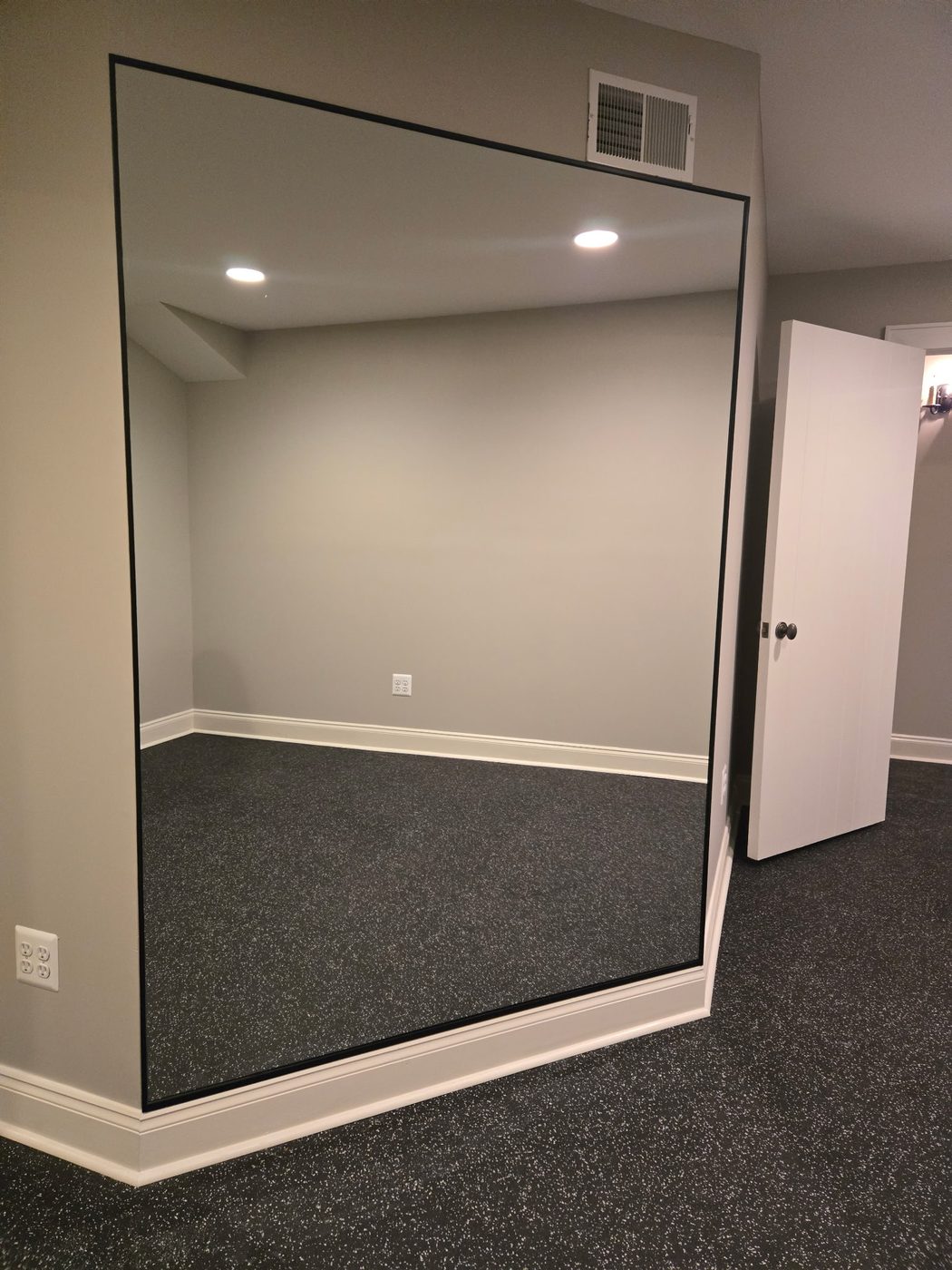
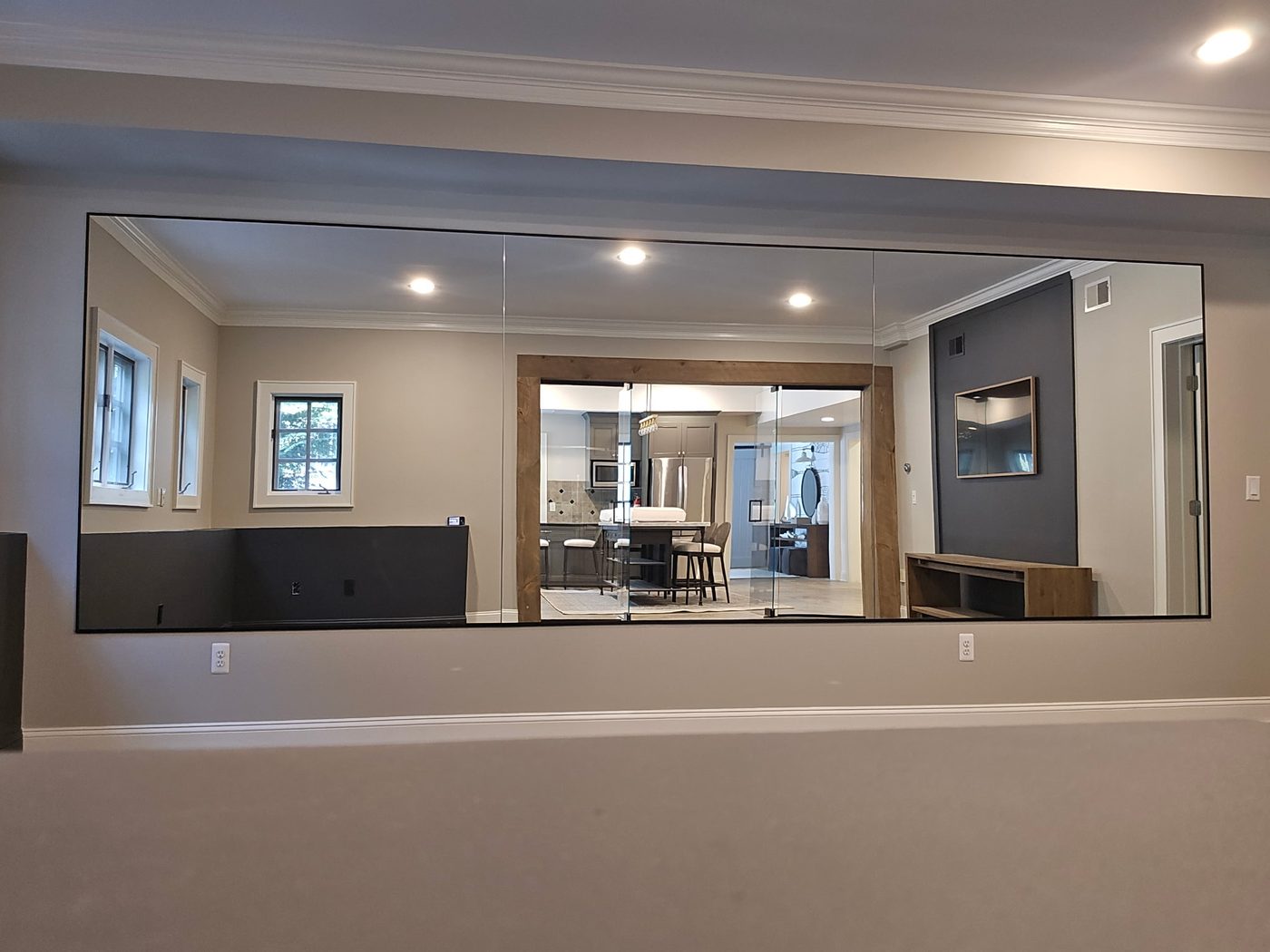
Mirror arrives in sheets, and there is a size past which one piece is either unavailable or unwise to move. Weight climbs with area, and a large piece has to survive a stairway, a turn at the top and a doorway before it gets anywhere near your wall. So a wall of mirror is almost always several panels. The only real questions are how many and where the joints fall. We take the measurements, work out a division that suits the room, and cut to that in Lodi rather than trimming glass on site.
Joints want to land where the room already has lines. Over a vanity that might be the centerline between two sinks, or in line with a cabinet edge, or level with a shelf. Behind a rack in a home gym, the joint belongs behind an upright rather than across your reflection. A seam you planned reads as a panel edge. A seam you did not reads as a crack. For hanging, the weight lands on cleats or clips set into solid backing, and the glass stands a hair off the wall so the surface behind it can dry.
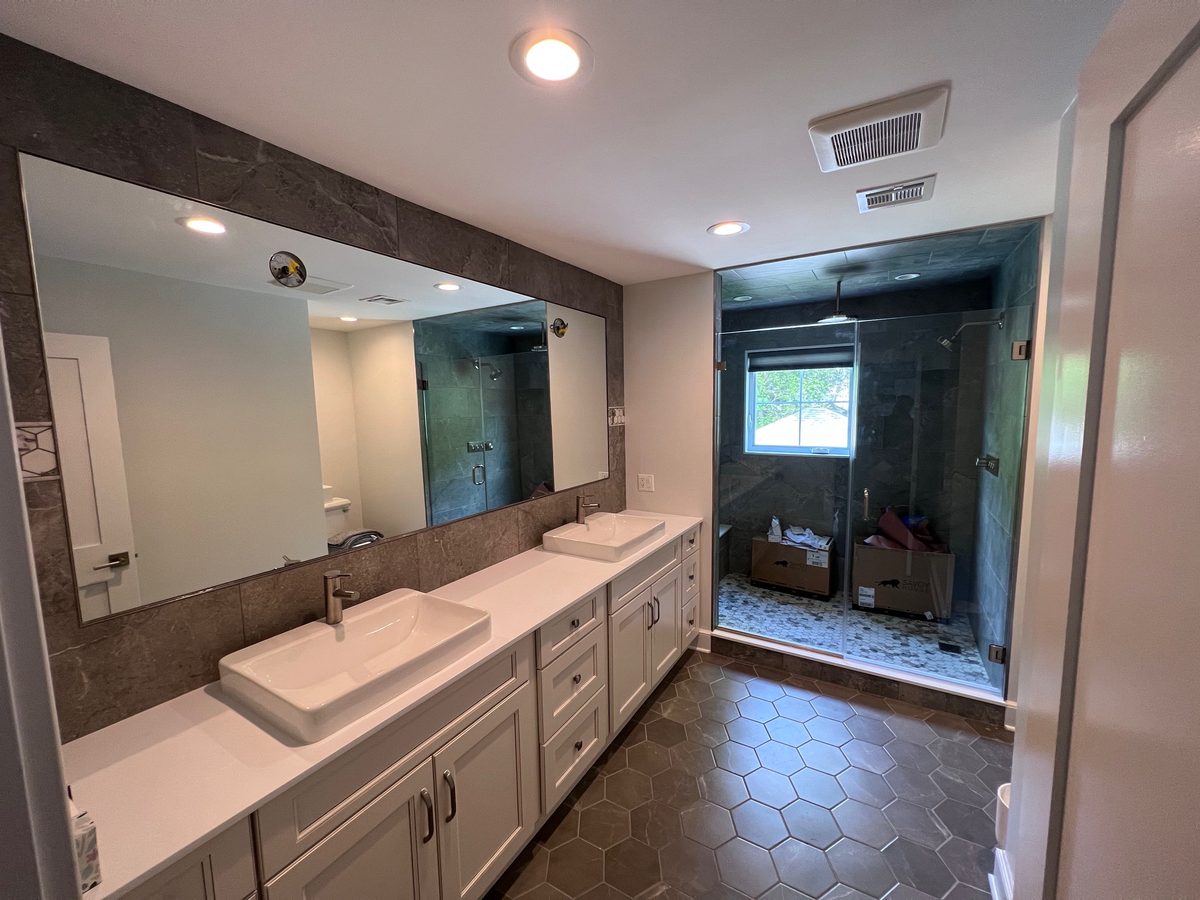
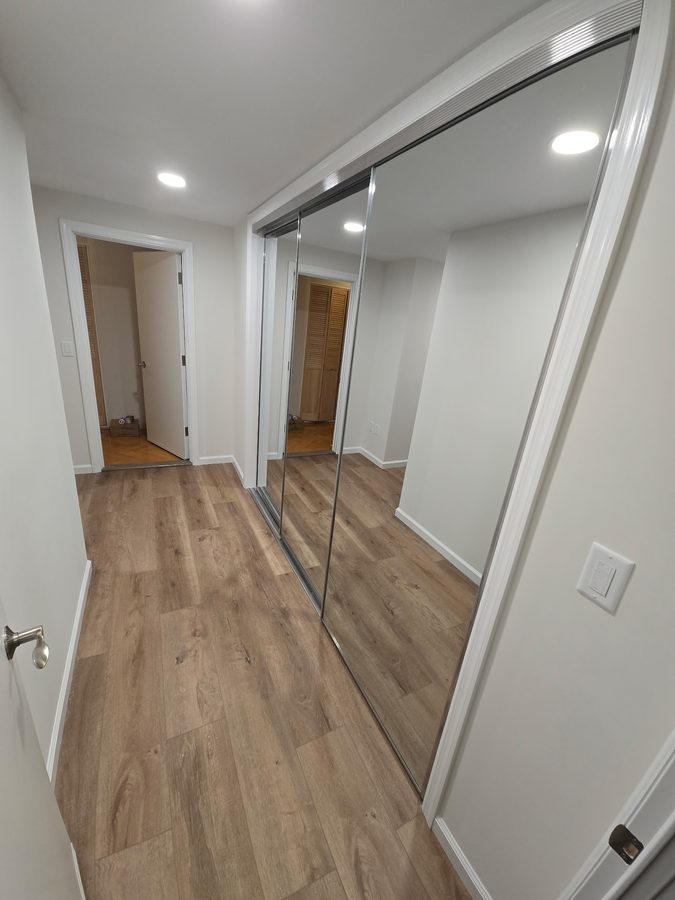
Over a vanity a mirror has one job and a couple of feet to do it in. Everywhere else in a house this size the job changes. A dressing room mirror has to show you the whole of an outfit, hem and shoes included, from far enough back that you can actually judge it. A gym wall has to hold a straight reflection across a long run so your form reads honestly from any point on the floor. A full length panel by a closet sits somewhere between the two. Same glass, but the height off the floor, the length of the run and the panel breaks all get decided by what you are standing back to look at.
The edge follows the same logic. A bevel is a wide band cut and polished around the perimeter, and it catches light well enough to read from across a large room, which suits a piece you look at as much as into. A polished edge is a clean flat finish you have to be close to notice at all, and on a gym run or a dressing room panel that is usually the right answer, because nothing about it competes with the reflection. We hold both against your wall at the measure. If there is shower glass going into the same house, one visit covers all of it.
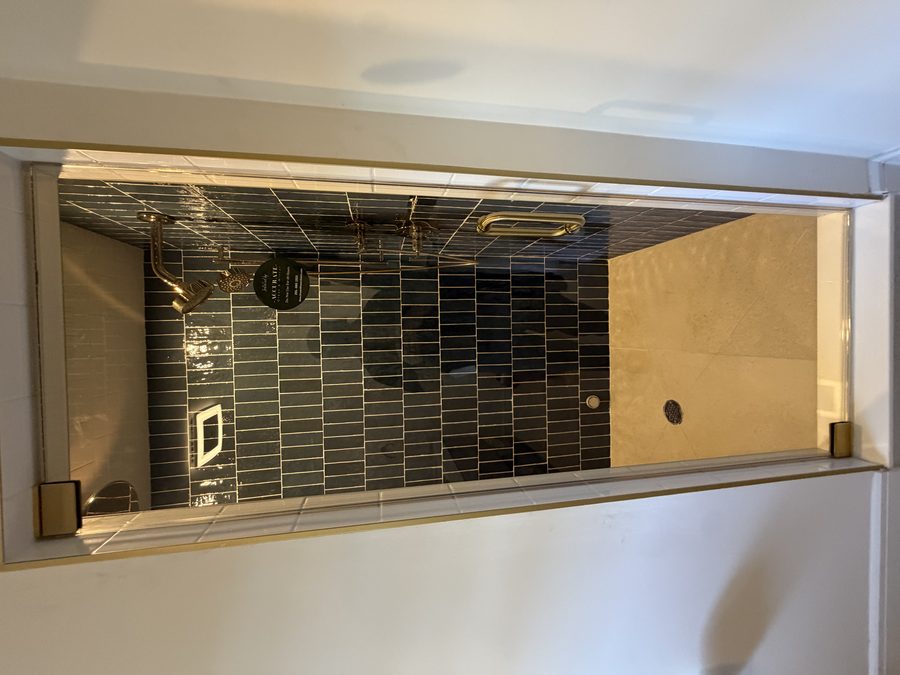
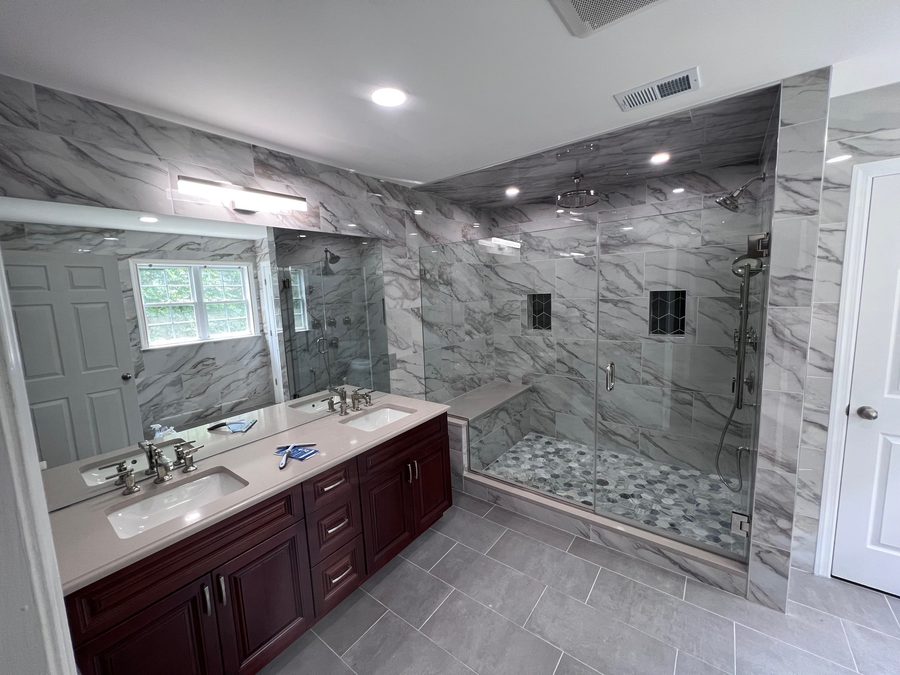
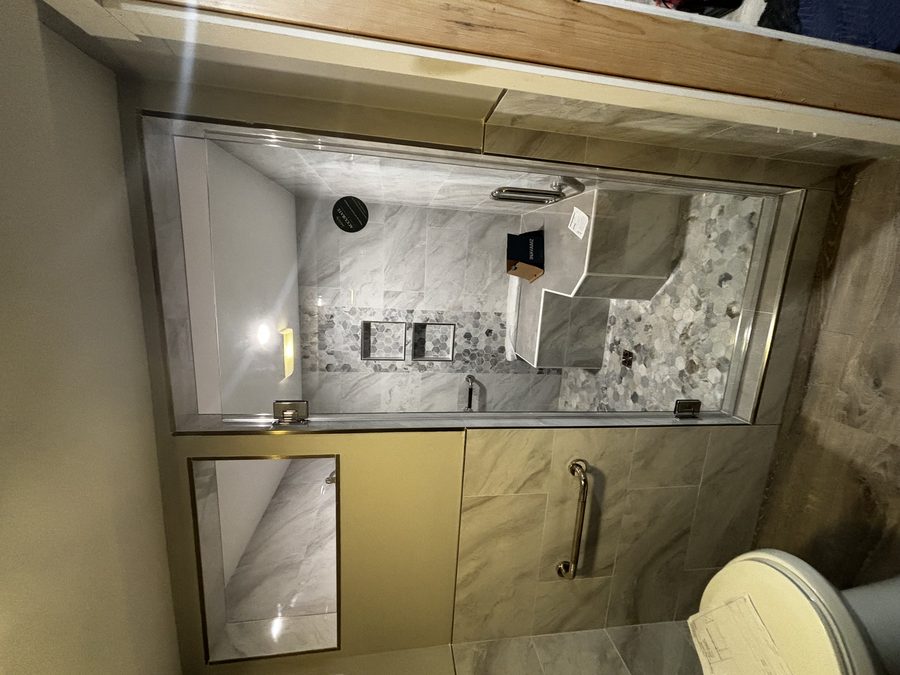
Look at the joints first. Mirror walls, vanity glass and full length pieces from homes around Franklin Lakes, every panel drawn on paper before it was ever cut. Enlarge any photo for the edge work.
More custom glass in Franklin Lakes: frameless shower doors, sliding & bypass shower doors, semi-frameless shower doors, shower door replacement, custom glass shower enclosures, steam shower enclosures, bathtub shower doors, glass railings, commercial glass. See everything on our Franklin Lakes, NJ page. Custom Mirrors nearby: Paramus, Ridgewood, Hackensack, Fort Lee, Lodi, Midland Park, Englewood, Teaneck, Fair Lawn, Mahwah, Wyckoff, Tenafly, Ramsey, Glen Rock, Montclair, Wayne. Learn more about our custom mirrors across Bergen, Passaic and North Jersey, or read the Vanity mirrors: framed vs. frameless and The complete custom mirror wall guide guides.
Bigger than most walls need, and smaller than most people picture. The limits are the sheet the glass comes from, the weight two people can control on a stair, and the door it has to pass through. Anything past roughly nine or ten feet of run gets planned as panels, and often smaller than that once the path into the room is measured. We take that measurement while we are there.
No, and in a tall room it often should not. Mirror carried up to a cathedral ceiling reflects a great deal of empty air and can leave a room feeling like a corridor. Stopping the glass on a line the room already has, the top of a door casing, a tile course, the height of a window head, usually looks more deliberate and reflects the part of the room worth reflecting.
Yes. A raked edge is cut to the angle we take off your wall, which means the measurement has to be right the first time, since the piece is only correct for one wall in one direction. We template rather than trusting a drawing, and the angle gets checked at both ends, because ceilings are rarely as straight as they look from the floor. The rake gets polished so the cut line is finished.
Not to the floor. Holding the glass up a few inches keeps the bottom edge clear of dropped weights, cleaning gear and whatever ends up leaning on that wall, and it makes the mirror easier to keep clean. We start it above the height of anything permanent along the wall and carry it high enough to catch you standing with your arms overhead. Set the equipment before we measure if you can.
Either works, and the difference is water. Setting the glass directly on a stone ledge means the bottom edge lives in whatever splashes up there, and over years that is how silvering starts to lift along an edge. Holding it a fraction above the stone, with a bead of silicone bridging the gap, keeps that edge dry and still reads as one surface. We do the second unless you want otherwise.
For a single piece, dimensions and a photo are enough to start. For a wall, someone comes out, and that measure costs nothing. Franklin Lakes is about twelve minutes from our Midland Park showroom at 108 Greenwood Ave, which is by appointment only, so a visit is easy either direction. There is glass to look at there, plus hardware finishes and samples, before you settle on an edge.
Glass for a Franklin Lakes wall gets cut and edged at 80 Industrial Rd in Lodi, which is why the sizes have to come off your wall and not out of a catalog. Tell us the room and the run: (201) 507-5918.
Glass for a Franklin Lakes wall gets cut and edged at 80 Industrial Rd in Lodi, which is why the sizes have to come off your wall and not out of a catalog. Tell us the room and the run: (201) 507-5918.
Text Jessica directly with photos. To speed things up, include: