In a house that has settled, a mirror can only agree with one thing at a time. The floor, the vanity top, a window casing and a true level line are four different references in a Glen Rock bathroom, and a custom mirror has to pick one of them. That choice is behind most of the mirror work we do here, alongside the cutting: sconce stems, an outlet at an awkward height, a tile line that stops partway up the wall. We measure the room, draw the piece, then cut and edge it in our own Lodi shop.
What is the mirror leveled to? Nobody asks, and everybody notices afterward. Four lines compete for it once a house has settled: the floor, the vanity top, the casing and true level. Hang it dead level and it may sit visibly crooked above a vanity that has dropped at one end. Line it up with the vanity and a spirit level will call it wrong, while your eye reads the room as square. Most of the time the vanity, or whichever horizontal is strongest in the room, wins, because that is what the eye compares it against. We work that out standing in the bathroom with you, rather than deciding it on install day with the piece already in our hands.
The cutting has to be settled just as early. Openings for sconce stems, a notch around an outlet box, a corner clipped to clear a window casing: all of it comes off the same sheet as the width and the height, and all of it happens before the edges are ground and polished. Cut a hole afterward and you risk the piece, and you have polished an edge that no longer exists. So the measure is never just a width. We locate every obstruction from a fixed reference, usually a wall corner or the vanity top, take it twice, and draw the piece on paper with those positions on it before anything is ordered. That holds for a plain vanity piece and equally for antique mirror.
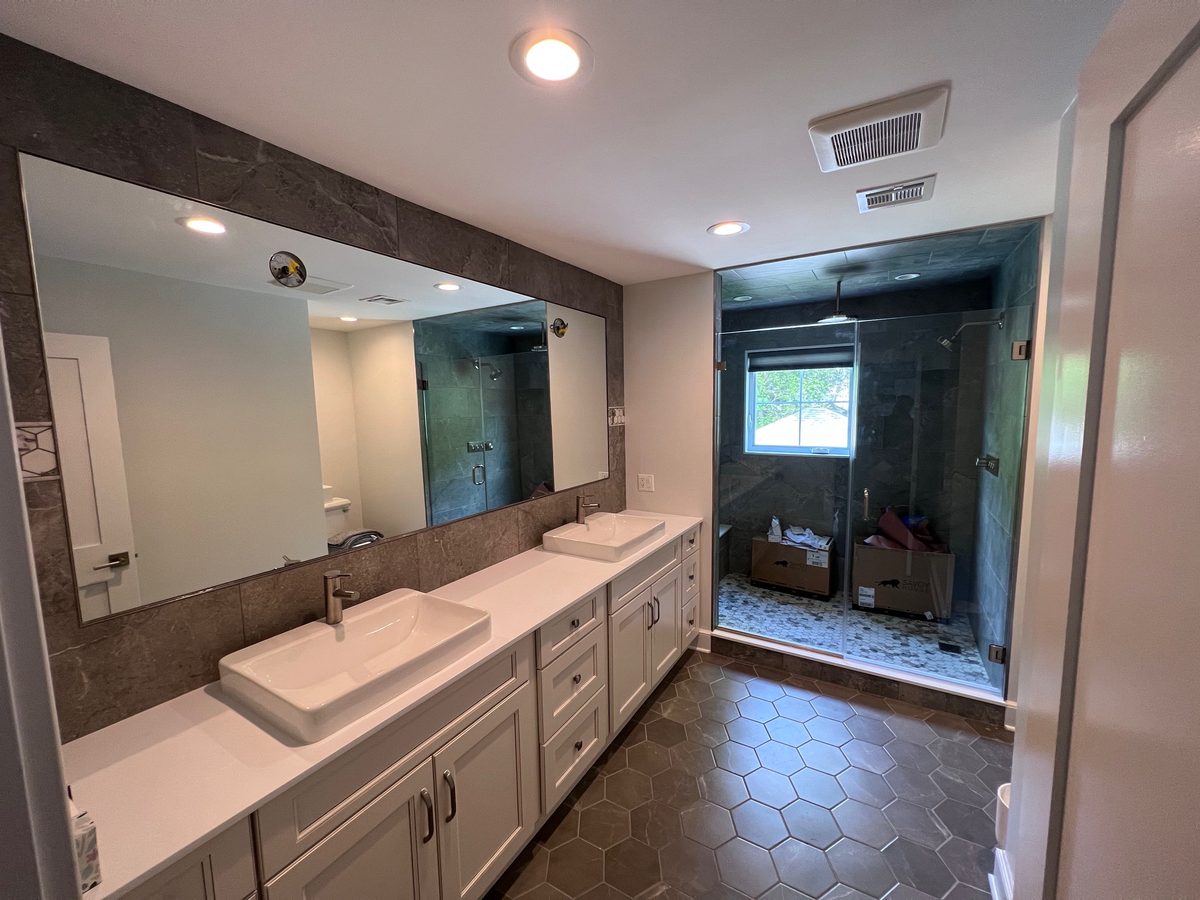
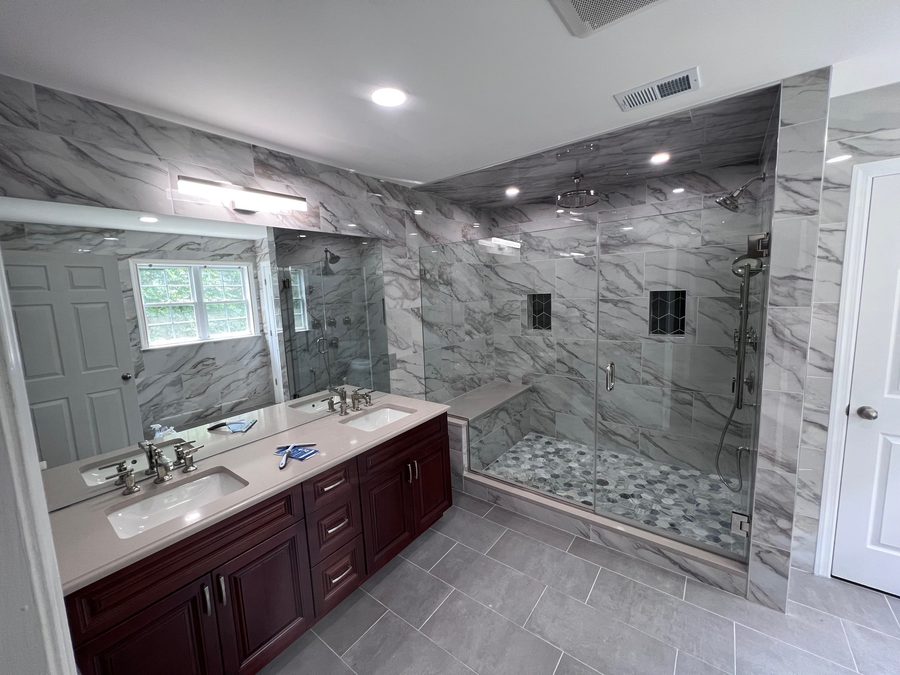
Bathrooms in Glen Rock's colonials, bungalows and split-levels are often compact, and that changes what mirror work has to account for. In a room this size the mirror and the shower enclosure are looking straight at each other. Stand at the vanity and the reflection contains the glass, the hardware on it and whatever tile is behind. So the two pieces have to be decided together. A beveled mirror opposite a heavily framed enclosure fights it. Matte black hardware on the shower and bright chrome clips on the mirror will read as two different rooms in one reflection. None of this is fussy taste. You will simply be looking at the two of them together every morning of the year, and they were most likely chosen years apart by different people.
That is also the argument for doing both on one visit. When the mirror and the enclosure are measured on the same trip, the finishes get chosen once, against the tile that is staying, in the light the room actually has rather than under showroom lighting. The dimensions help each other too: knowing where the enclosure's fixed panel will land tells us how far the mirror can run toward that wall before the two crowd each other, and knowing where the mirror stops tells us whether a sconce has to be worked around or can be left clear. It is one measure, one written quote covering both pieces, and one crew in the house on install day instead of two.
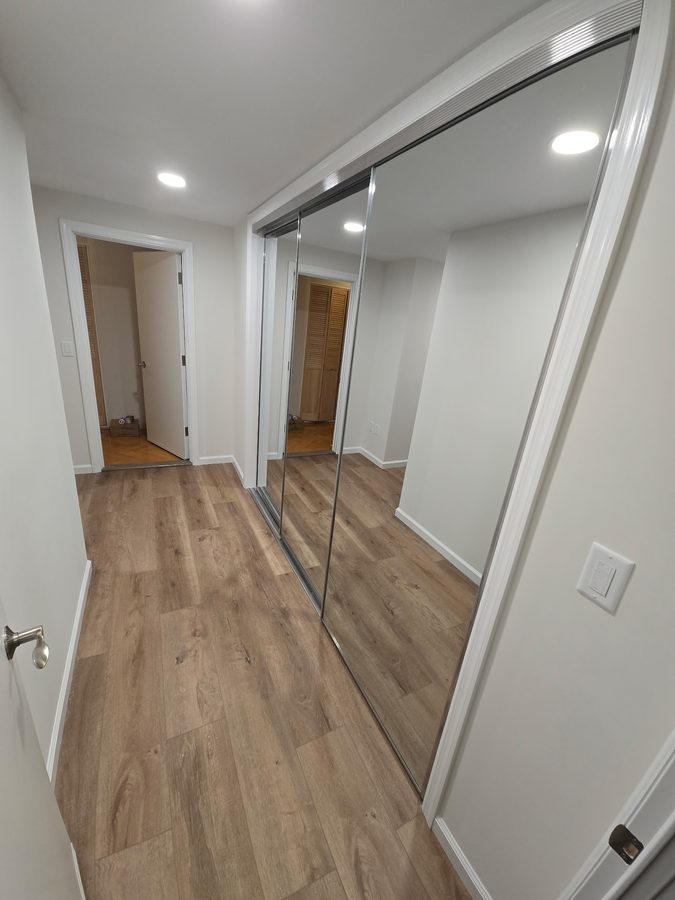
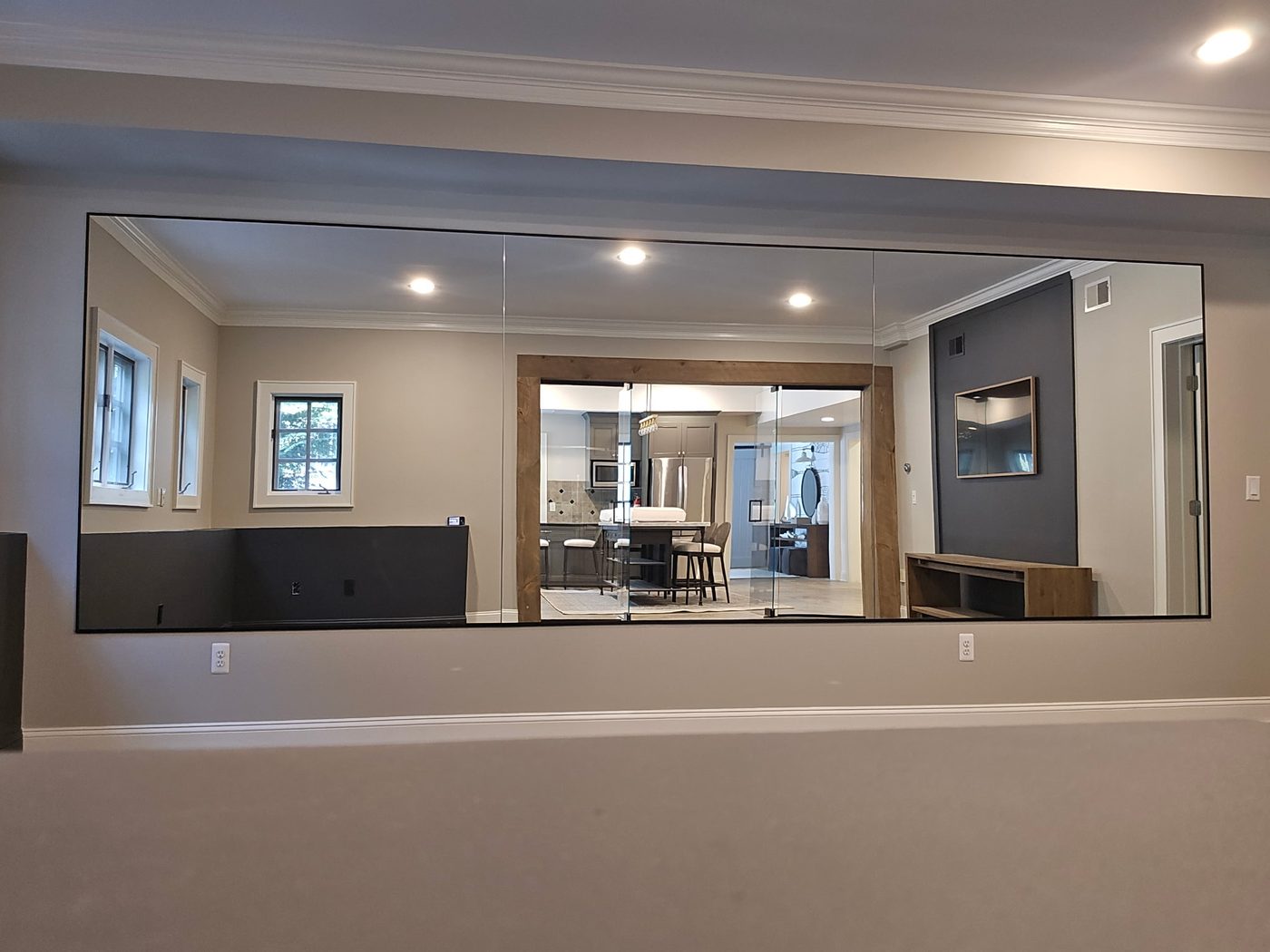
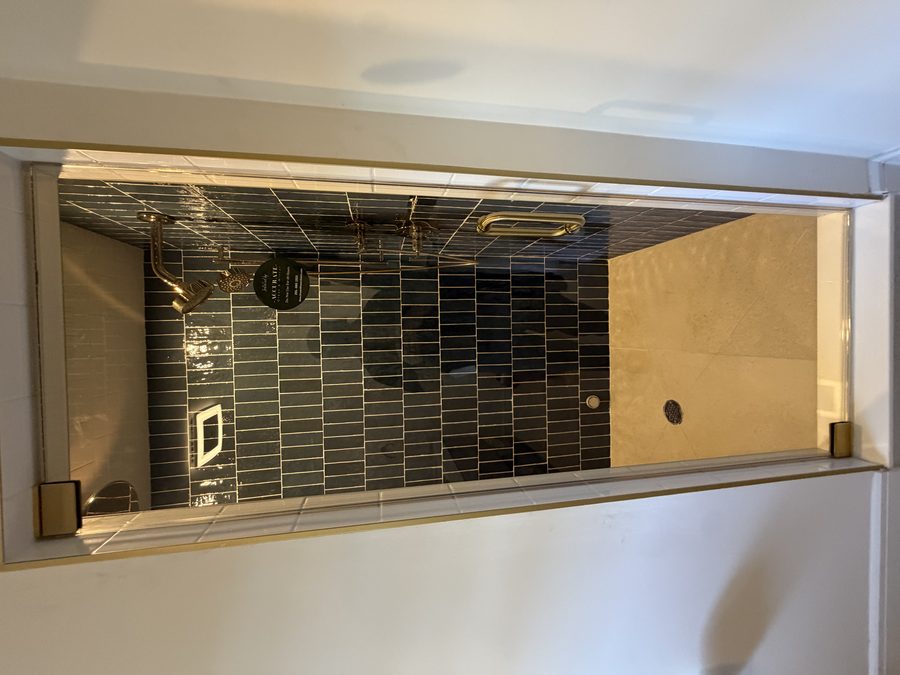
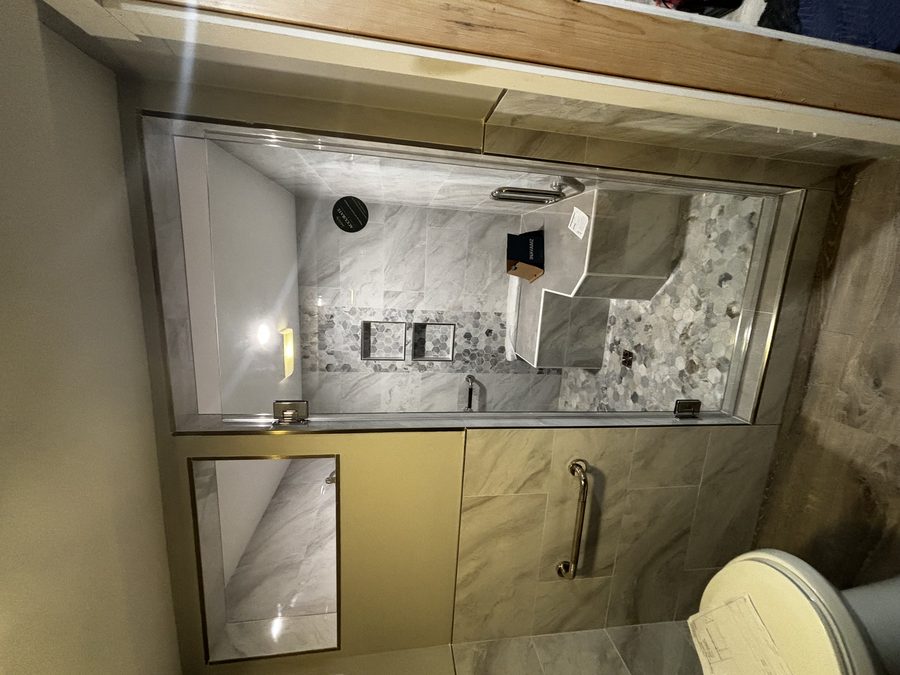
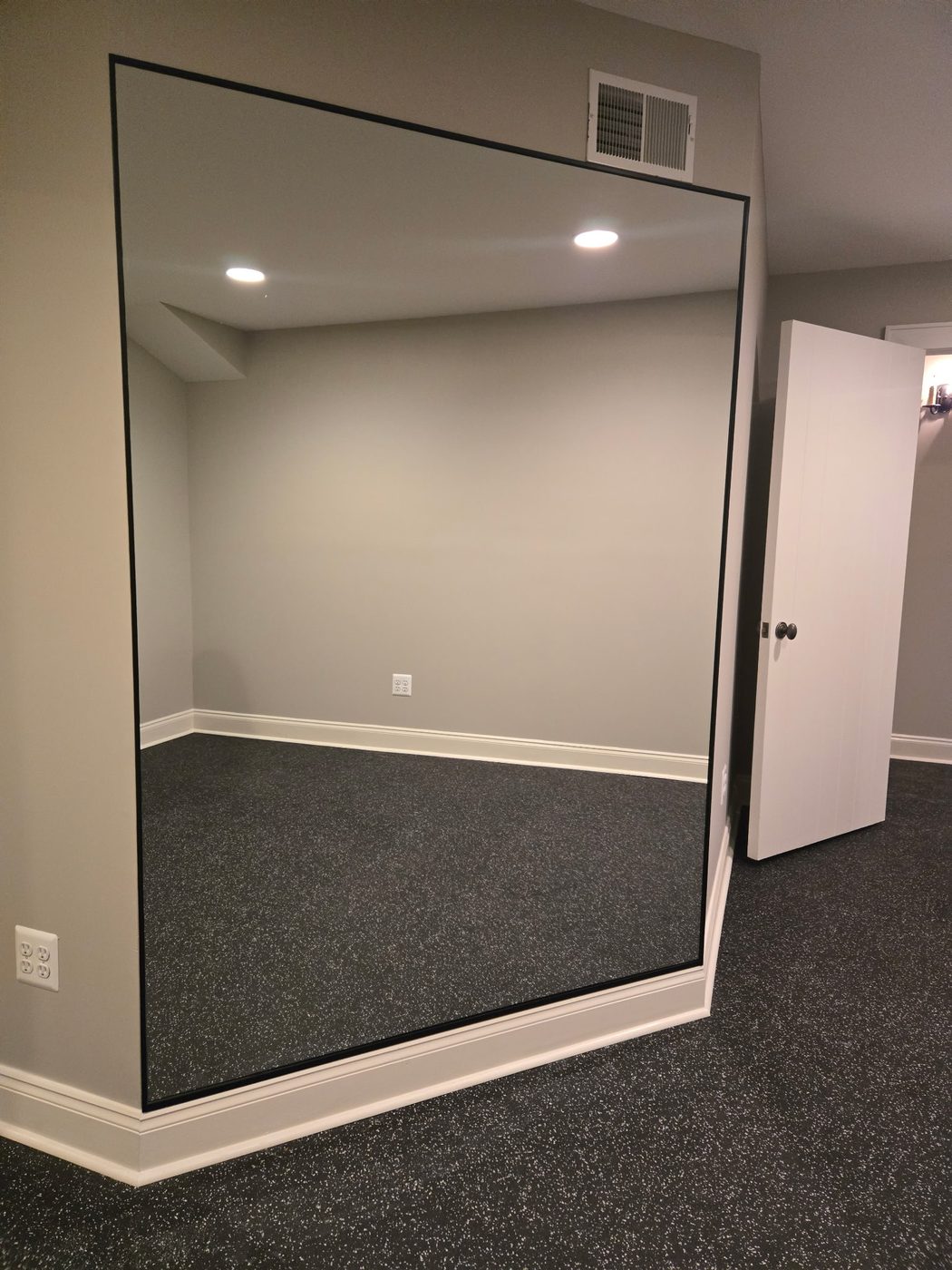
Forty-eight inches over a vanity. A full length panel beside a closet door. A run that stops where the wall tile stops. Mirror work from Glen Rock houses, every piece cut and edged in our Lodi shop. Look at the line each one follows, because it is rarely the line a level would draw.
More custom glass in Glen Rock: frameless shower doors, sliding & bypass shower doors, semi-frameless shower doors, shower door replacement, custom glass shower enclosures. See everything on our Glen Rock, NJ page. Custom Mirrors nearby: Paramus, Ridgewood, Hackensack, Fort Lee, Lodi, Midland Park, Englewood, Teaneck, Fair Lawn, Mahwah, Wyckoff, Tenafly, Franklin Lakes, Ramsey, Montclair, Wayne. Learn more about our custom mirrors across Bergen, Passaic and North Jersey, or read the Vanity mirrors: framed vs. frameless and The complete custom mirror wall guide guides.
It could, and it is worth planning with the mirror rather than after it. Glass shelving is cut to size and edged the same way, in tempered glass, and it fastens to the wall rather than to the mirror, so the two need a gap between them that suits what will stand on the shelf. We set the shelf height against the faucet and the mirror's bottom edge at the measure, so a toothbrush cup clears one and does not crowd the other.
We look for the next strongest horizontal in the room, which in these bathrooms is usually the top of the wall tile or the head of the window. One of those is what your eye will compare the mirror against, so that is what it gets set to. Width comes off the centerline of the sink rather than the wall, unless the two are far enough apart that centering on the wall reads better. We lay both out on the measure.
Yes, and it comes up often in these houses. The recessed cabinet stays where it is, and the mirror gets cut to sit beside it or to run above the vanity beside it, with the edge nearest the cabinet finished the same as the rest. What we check is the reveal: a gap of an inch reads as a mistake, while a deliberate few inches, or butting the two so they touch, reads as a decision. We set that with you at the measure.
They can, but that is an electrician's job and not ours. What we can do is cut the piece for either arrangement, and say which one the room is asking for. Sconces that sit off center on a mirror are far more noticeable than sconces that sit off center on a wall, so if they are staying put, the mirror is usually sized and placed to make their spacing look deliberate.
They do not go on the glass. Hung through a mirror, a towel ring or a dryer holder puts a daily tug on the piece itself. So one of two things happens: they move to the wall beside the mirror, with the old screw holes ending up hidden behind it, or they stay put and the piece is sized to stop short of them with a clear margin. We note where each one sits at the measure so the choice is on the drawing.
It can, and in an older bathroom that is often the tidier answer. Where wall tile stops partway up, a mirror can be sized to start just above the top edge so the two lines run parallel, or brought down to touch the tile and sealed at the joint. What we avoid is a piece ending a fraction off the tile line, because a mismatch of half an inch is what your eye finds first. We take the tile height at both ends, since it is rarely the same.
The wall decides this one. Point us at it and say what runs across it: the top of a vanity, a tile line, a pair of sconces, a window casing. That is what sets where the piece stops and what it agrees with. The free in-home measure takes care of the rest. Call or text (201) 507-5918.
The wall decides this one. Point us at it and say what runs across it: the top of a vanity, a tile line, a pair of sconces, a window casing. That is what sets where the piece stops and what it agrees with. The free in-home measure takes care of the rest. Call or text (201) 507-5918.
Text Jessica directly with photos. To speed things up, include: