
Quick answer: A custom shower door is a tempered-glass enclosure built and installed to fit your exact bathroom opening. It differs from a big-box door in that every dimension is measured on site, the glass is fabricated to those real measurements, the hinges and clips anchor into wall studs (not just tile), and the enclosure accounts for the out-of-plumb walls common in older NJ homes. The result fits flush, seals watertight, and looks like the bathroom was designed around it — because, effectively, it was.
This pillar guide is the umbrella overview for everything related to custom shower doors in New Jersey. It links out to focused deep-dives on cost, care, thickness, and frameless vs. semi-frameless if you want to go further on any single topic. If you are at the start of a bathroom project, read top to bottom. If you already know what you want and need a price, skip to how much it costs.
What is a custom shower door?
A custom shower door is a tempered safety-glass enclosure that is measured, fabricated, and installed to fit one specific bathroom opening. The category covers frameless, semi-frameless, and framed construction; inline, corner, neo-angle, sliding, steam, and tub layouts; multiple glass thicknesses and types; and a range of hardware finishes. The defining feature is that nothing about it is "standard" — every dimension, angle, and seal is built for your room.
How it differs from a big-box door: Stock shower doors assume your opening is a perfect rectangle of one of about a dozen widths. North Jersey bathrooms are almost never perfect rectangles. Plaster walls bow. Stud bays shift over decades. Tile thickness varies. Curbs slope. A stock door bridges those variances with bulky metal channels and rubber gap-fillers — which is why builder-grade enclosures so often leak, look messy at the edges, or develop mildew in the seal lines. A custom door measures the real opening, then fabricates the glass to match it.
What "custom" actually buys you is three things: a perfect mechanical fit, the freedom to choose any combination of layout, glass, and hardware, and a single accountable shop on the back end. There is no manufacturer to call and no installer to argue with — you have one phone number for the lifetime of the enclosure.
Frameless vs. semi-frameless vs. framed
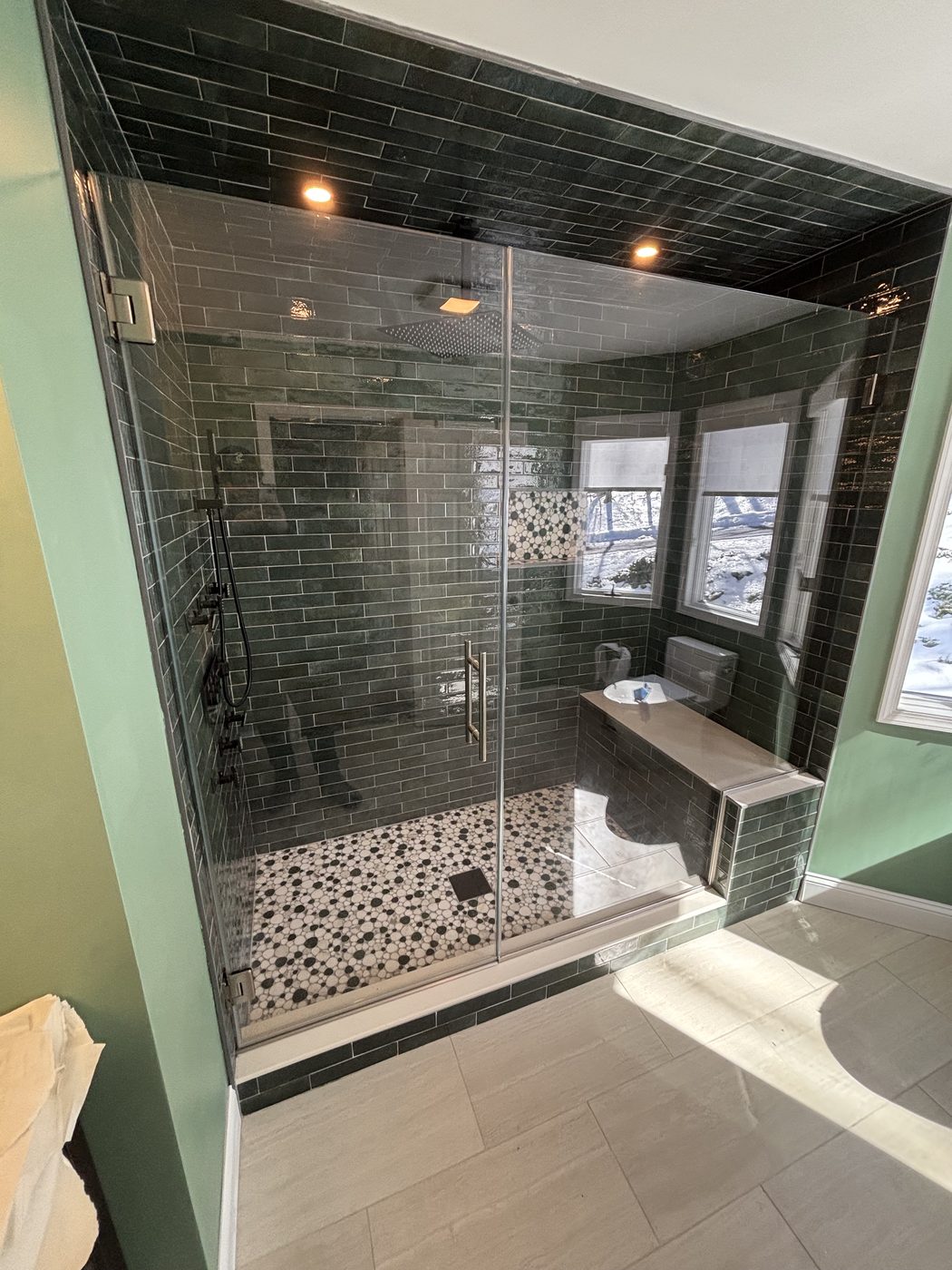
Every shower door we install falls into one of three structural families. The choice mostly comes down to budget, the look you want, and how much you care about cleaning.
| Style | Cost | Look | Glass thickness | Best for |
|---|---|---|---|---|
| Framed | $ | Defined metal edges around all glass | 3/16″ – 1/4″ | Tightest budgets, tub combos, rentals |
| Semi-Frameless | $$ | Slim frame at perimeter, frameless door edge | 1/4″ | Style on a budget, busy households |
| Frameless | $$$ | Almost invisible — clips & hinges only | 3/8″ – 1/2″ | High-end, open, spa-like baths |
Framed doors are the most affordable but read as builder-grade in 2026 — the metal channel around every edge is the visual giveaway. Semi-frameless splits the difference, with a slim metal perimeter and a frameless door edge so the door reads clean while the structure stays simple. Frameless is the premium choice: the glass carries its own structural load, so there is no metal channel to interrupt the view of your tile. For a head-to-head between the two upper tiers, see our frameless vs. semi-frameless guide.
What this means for cleaning: Framed doors have multiple corners and channels where soap scum collects and mildew grows. Frameless doors have almost none — clips and hinges plus a single vinyl seal at the door edge. That single design choice is why frameless enclosures stay looking new for years longer in busy NJ households.
Shower enclosure shapes & layouts
The second decision after style is layout — how the glass meets your walls, tub, or curb. Every bathroom has a natural fit. These are the six configurations we install most often.
Inline (single door + fixed panel)
The most common layout. A swinging door and a stationary fixed panel run along a single wall, sealing off a walk-in shower. The door pivots on hinges anchored to one wall; the fixed panel is clipped to the other. Simple, elegant, and the easiest configuration to clean. Works in almost any rectangular bath where the shower runs along one wall. Inline is also the most cost-efficient frameless layout because there is no glass-to-glass joint and no corner clip to fabricate.
Corner
Two walls of glass meet at a 90-degree corner, with the door on one of them. Great for square showers tucked into a bathroom corner; opens up the room visually because the corner of the shower is glass rather than tile. The door can swing in or out, and the inside corner is a single glass-to-glass joint that we polish smooth. See our corner shower enclosures page for examples.
Neo-Angle
A five-sided enclosure where two walls of glass meet a corner door at 45-degree angles, with a third short panel of tile on each side. Distinctive look, footprint-efficient in tighter bathrooms (it tucks into a corner without forcing a fully square enclosure), and a true custom-glass project — every neo-angle is templated to the exact opening because the two 45-degree side walls are rarely identical. Browse neo-angle enclosures for examples.
Sliding / Bypass
Two glass panels slide past each other on a track. Ideal for tubs and tight bathrooms where a swinging door would hit a vanity or toilet. Modern sliders use frameless or semi-frameless construction with hidden rollers running on a slim top track — a far cry from the bulky framed metal slider in your parents' guest bath. They are also a strong answer for wide openings (60″+) where a single swinging door would be awkward. See our sliding frameless shower doors page.
Steam
A steam enclosure is sealed to the ceiling with an operable transom window for venting, plus upgraded seals throughout the door and panel joints. Turns a shower into an in-home spa. Glass is typically 3/8″ or 1/2″ to handle the heat cycling, and the steam generator (a separate boiler tucked into a nearby closet or vanity) feeds steam through a wall-mounted head inside the enclosure. See our steam shower enclosures page for the engineering details.
Tub
Glass set onto the rim of a tub, either as a fixed panel (the "shower screen" look, increasingly popular in modern primary baths) or as a sliding bypass over the tub. The right call for tub-shower combos that you still want to feel modern. Hardware is anchored into wall studs, not the tub deck, because the tub itself moves slightly over time and the glass needs an immovable anchor.
Glass thickness explained
For frameless construction, you are choosing between two thicknesses. 3/8″ is the sweet spot for most enclosures — rigid, solid-feeling, and notably less expensive than 1/2″. 1/2″ is the premium pick, used for unusually large panels, very tall enclosures, oversized swinging doors, or homeowners who simply want the most substantial feel possible. The added weight gives the door a vault-like solidity that is instantly noticeable when you open it.
| Thickness | Used in | When to spec it |
|---|---|---|
| 3/16″ | Framed only | Tub doors, tight budgets, rental units |
| 1/4″ | Framed + semi-frameless | Mid-tier installs, semi-frameless inline doors |
| 3/8″ | Frameless | The default for the majority of frameless enclosures |
| 1/2″ | Frameless | Oversized panels, tall enclosures, premium feel |
All shower glass we install is tempered safety glass, regardless of thickness — required by code for showers and tubs. If it ever breaks, it crumbles into small, relatively blunt pieces instead of dangerous shards. For a deeper look at how thickness affects feel, cost, and structural performance, see our shower glass thickness guide.
Tip: Doors taller than 80″ and panels wider than 36″ generally benefit from stepping up to 1/2″ glass. The extra rigidity prevents flex at the latch side and keeps the seal tight over years of daily use.
Glass types & finishes
Once you have picked a thickness, you choose the glass itself. Each type changes the look of your enclosure dramatically. All are available in 3/8″ and 1/2″ frameless and in the thinner gauges used for semi-frameless.
| Glass type | Look | Best for |
|---|---|---|
| Clear | Crystal clean; faint green at thick gauges | The default; most economical |
| Low-Iron / Starphire | Ultra-clear; no green tint | Primary baths, designer tile, white marble |
| Frosted (acid-etched) | Full privacy; passes light | Shared baths, panels facing a vanity or window |
| Reeded / Fluted | Vertical ribbed texture | 2025–2026 design trend; often an accent panel |
| Rain / Cascade | Subtle wavy obscuration | Privacy without going full-frosted |
| Bronze | Warm brown tint | Brass hardware, walnut vanities, dark stone |
| Smoke / Grey | Cool grey tint | Matte black hardware, high-contrast tile |
| Bubble / Seedy | Decorative textured pattern | Transitional baths, accent walls |
Standard clear glass has a faint greenish tint that becomes more visible at 3/8″ and 1/2″ thicknesses, especially at the cut edges. Low-iron (Starphire) glass removes that tint, so white marble reads truly white and tile colors stay accurate. It is the upgrade most often spec'd by designers in primary baths — see our low-iron glass shower doors page.
Hardware: hinges, handles, knobs, and clips
The hinges, handles, clips, and (if applicable) header bar all come in a finish that should coordinate with your plumbing fixtures and lighting. We stock 15 hardware finishes; the most popular in NJ right now are:
- Matte Black — the dominant finish in 2025–2026, especially in modern and transitional baths.
- Brushed Nickel — the consistent all-rounder that works with almost any plumbing line.
- Chrome — bright, classic, the most economical option.
- Brushed Brass / Satin Gold — back in a big way, especially in warm primary baths with white or cream tile.
- Oil-Rubbed Bronze — warm, traditional, beautiful with stone and wood.
- Polished Nickel — slightly warmer than chrome, an upscale traditional choice.
- Polished Brass — bright high-gloss gold for formal baths.
- Antique Bronze — distressed warm finish for character homes.
Hinges are spec'd to the door weight — heavier 1/2″ glass needs heavier-duty hinges with a wider load rating. Handles range from minimal knobs (a single 2″ ball or T) to ladder-style towel-bar handles that double as drying rails. Clips are the smallest visible piece of hardware in a frameless enclosure and matter more than people expect; finish-matching them to the hinges is the detail that sells the whole assembly.
Bring a sample of your plumbing trim to your measure and we will match the finish exactly. Mixed-metal looks (matte black hinges with brass handles, for example) are also fine if intentional — we will sample both before you commit.
The protective coating upgrade
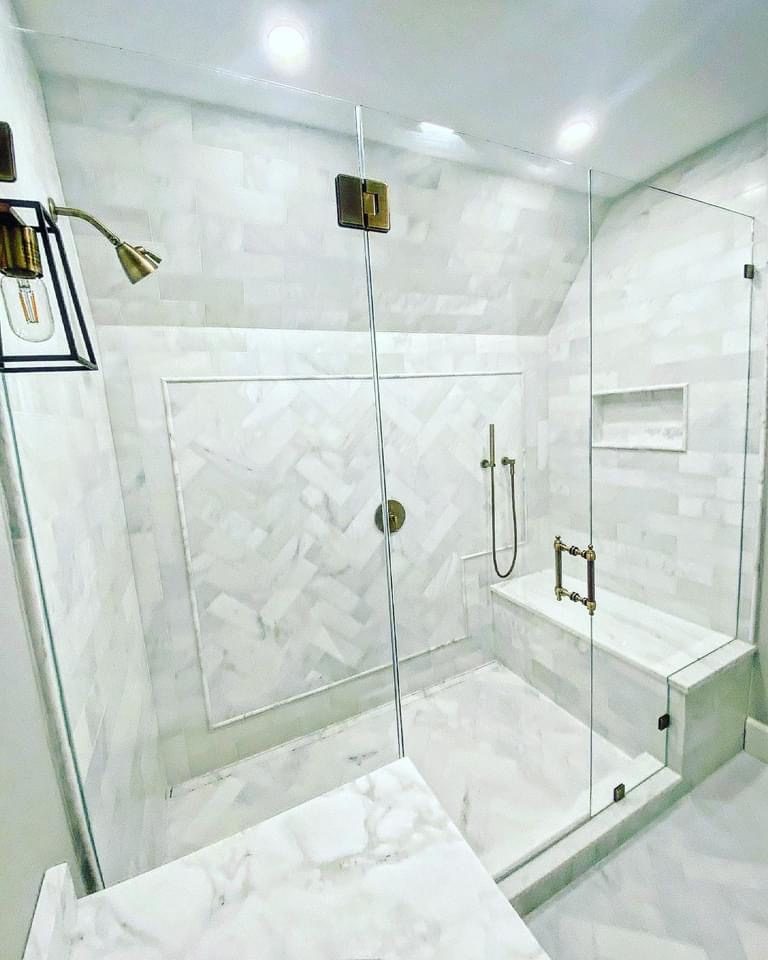
One of the best upgrades you can add — and one most homeowners do not know exists. A factory-applied hydrophobic coating bonds permanently to the glass surface, making water and soap bead up and sheet off rather than clinging. The practical effect in hard-water North Jersey: dramatically less mineral spotting, fewer soap-scum streaks, and glass that stays looking like the day it was installed for years.
Why NJ water matters here: Bergen and Passaic County municipal water averages 90–150 ppm hardness, with some wells running well above that. Every shower deposits a thin film of dissolved calcium and magnesium on the glass; left to dry, those minerals etch into the surface microscopically and cause the hazy permanent fog you see on older enclosures. The coating fills those micro-pores so the minerals never bond. The coating is worth the modest upcharge in almost every NJ bathroom — see our protective glass coating page for how it works and the data behind it.
The installation process at AGM
Every custom enclosure we build follows the same four steps. There are no surprises and no middlemen.
1. Measure
We come to your home, talk through glass and finish options, and field-measure your actual opening. We check for plumb at multiple points, confirm tile thickness, locate wall studs, and inspect the curb or threshold for slope. Bathrooms are rarely perfectly plumb or square, so this measure is the foundation of everything else. You get a firm, itemized written quote — no obligation.
2. Fabricate
Once you approve the quote, we cut, edge, and finish the glass in our own Lodi shop. Templating to your real dimensions (not standard sizes) is what makes a custom door fit perfectly. Edges are polished, holes for clips are drilled, the tempering kiln runs the glass through a heat cycle that makes it safety-rated, and any coating is applied before delivery. Typical fabrication runs one to two weeks.
3. Install
Our own crew (not a sub) installs your enclosure. Hinges anchor into wall studs through the tile, glass is set level and watertight with the seals and sweeps included, and we walk you through how everything works before we leave. Most installs are a half day to a full day on site.
4. Coating (optional, applied at fabrication)
If you opted for the protective coating, it is applied as part of the fabrication step before delivery. The glass arrives at your home already treated — you will see the water-beading effect from the first shower. The coating bonds permanently to the glass surface, so there is nothing to reapply and nothing to maintain on your end.
How much does a custom shower door cost in NJ?
Most custom frameless shower doors in North Jersey fall between $1,400 and $3,000 for 3/8″ glass, with premium 1/2″, low-iron, or steam enclosures running $2,500–$5,000 or more. Framed and sliding tub doors are the most affordable.
| Type | Typical range* |
|---|---|
| Framed / sliding tub door | $700 – $1,300 |
| Semi-frameless | $1,000 – $1,800 |
| Frameless — 3/8″ | $1,400 – $3,000 |
| Frameless — 1/2″, low-iron or steam | $2,500 – $5,000+ |
*General estimates for the North Jersey market. The five biggest factors that move the price are glass thickness, enclosure size and configuration, glass type, hardware finish, and site conditions (out-of-plumb walls, awkward access, second-floor stair carries). For a full breakdown including how to budget for a steam upgrade, see our shower door cost guide.
Care & maintenance
A custom glass shower should look new for years. The two habits that matter most:
- Squeegee after every shower. Takes 30 seconds and prevents mineral spots from etching the glass surface. The number-one reason older glass enclosures look hazy is years of unsqueegeed shower water drying on the panels.
- Weekly wipe with a pH-neutral cleaner and microfiber. Skip the ammonia-heavy products on coated glass and skip the abrasive scrubbers entirely. A diluted dish-soap solution and a quality microfiber gets you 95% of the way.
If you spec the hydrophobic coating, the squeegee step becomes optional and weekly maintenance becomes monthly. For the full routine — including how to deal with hard-water buildup that is already there, and which products are safe on coated and tinted glass — see our glass shower care guide.
Common pitfalls to avoid
After 40+ years of custom installs in North Jersey, these are the mistakes we see most often when a homeowner has used a low-bid shop or a big-box installer:
- Not accounting for out-of-plumb walls. Most NJ homes built before 1980 have walls that are out of plumb by 1/4″ or more over the height of a shower. Stock doors gap badly against the tile and leak. A real custom measure shims, scribes, or fabricates a slight taper into the panel so it sits flush.
- Skipping the protective coating. In NJ's hard water, uncoated glass starts showing mineral haze within 12–18 months of daily use. Adding the coating during fabrication is dramatically cheaper than restoring etched glass later.
- Choosing the wrong thickness for the panel size. A 3/8″ panel works beautifully up to roughly 36″ wide and 80″ tall. Beyond that, the glass flexes and the seal does not stay tight. Tall ceilings and oversized doors should be 1/2″.
- Hinges anchored to tile, not studs. Cheap installs use plastic anchors set in the tile face. Heavy 3/8″ and 1/2″ doors will eventually pull those anchors loose. Every hinge we install reaches the wall stud behind the tile.
- Buying without seeing samples in your light. Bathroom lighting (warm vs. cool, natural vs. LED) changes how every finish reads. Always insist on physical samples in your room before you commit.
- Ignoring the threshold slope. If the shower curb slopes outward (away from the pan), water will run under the door no matter how good the seal is. We check the slope at measure and recommend a sill kit or pan correction if needed.
Why Bergen County trusts AGM
Three reasons homeowners and contractors call us back:
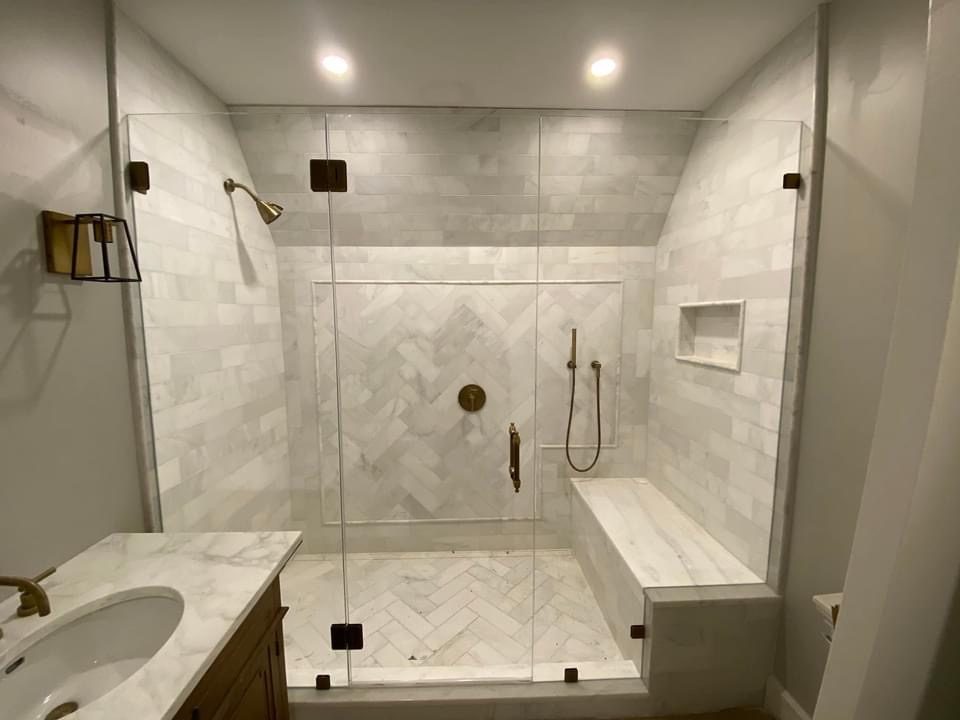
- 40+ years in Bergen County. The same family-run shop, the same install crew, the same showrooms in Lodi and Midland Park. You are not getting a national franchise with a different installer every quarter.
- In-house fabrication. The glass is cut, edged, drilled, and tempered in our own Lodi shop. No middleman, no shipping delays from out-of-state suppliers, no "we don't make that anymore" answers.
- One number for the lifetime of the door. If a hinge ever loosens or a seal needs replacing, you call us directly. Warranty claims do not go through a manufacturer call center.
We serve all of Bergen County and most of North Jersey, including Hackensack, Englewood, Fort Lee, Franklin Lakes, Fair Lawn, Glen Rock, Hoboken, Jersey City, and the surrounding towns. If you are replacing an old enclosure, we can usually pull the existing door at measure and have you back in service within a few weeks.
Putting it all together
A custom shower door comes down to a handful of decisions: the style (framed, semi-frameless, or frameless), the layout (inline, corner, neo-angle, sliding, steam, or tub), the glass thickness (3/8″ or 1/2″ for frameless), the glass type (clear, low-iron, frosted, reeded, etc.), the hardware finish, and whether to add the hydrophobic coating. Each one is independent — you can mix and match — and each has cost and design implications we will walk through at your in-home measure.
The two decisions that matter most for the final look are the style (frameless makes the room feel bigger and more spa-like) and the hardware finish (which sets the design tone for the whole bath). The two decisions that matter most for the long-term experience are the glass thickness (heavier glass feels more solid for decades) and the protective coating (which keeps it looking new). Get those four right and you will be glad you did every time you walk into the bathroom.
Ready to start your project?
Tell us about your bathroom and we will schedule a free in-home measure — firm quote, no obligation, samples of glass and finishes brought to you.
Get a Free In-Home Measure