Two-sided frameless corner enclosures that turn the corner of your bathroom into a clean, watertight glass shower — typical in older Bergen and Passaic homes where space is at a premium.
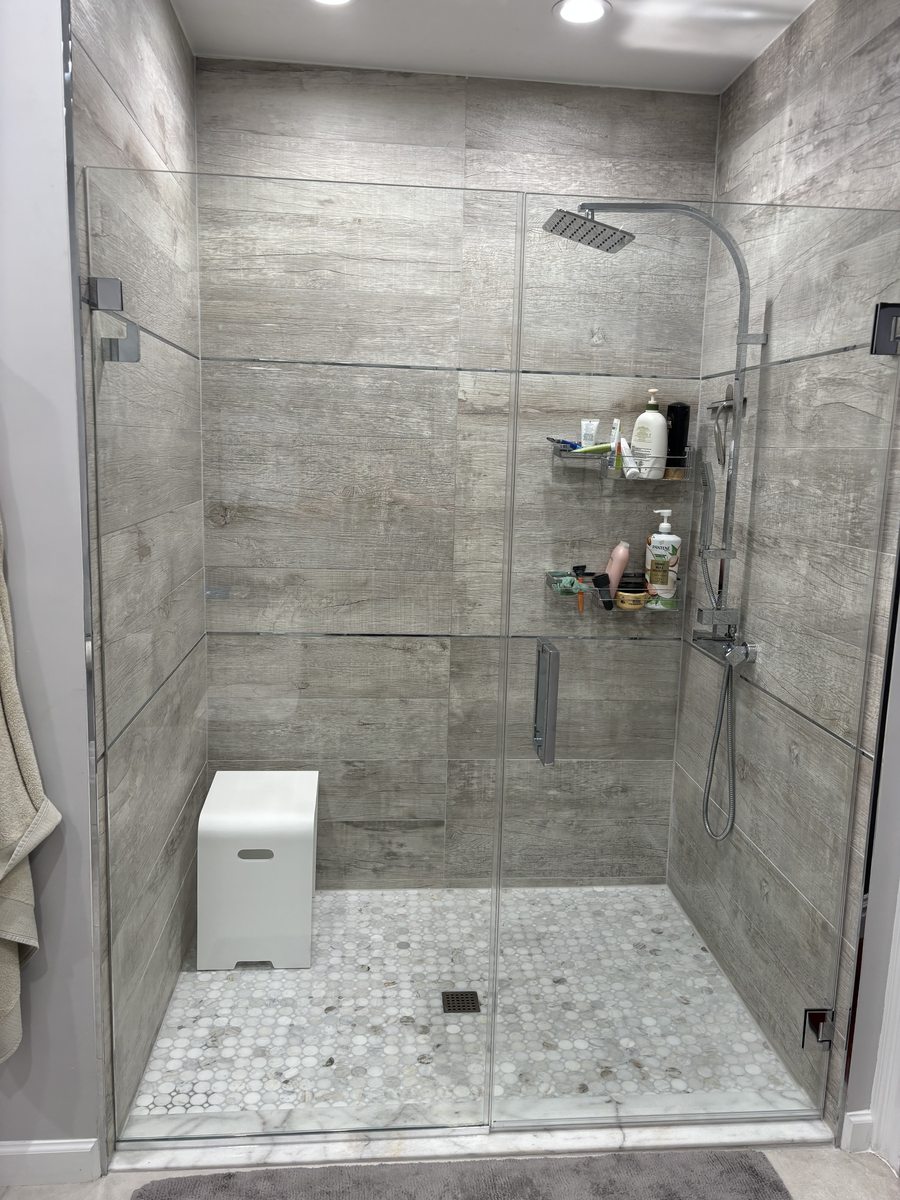
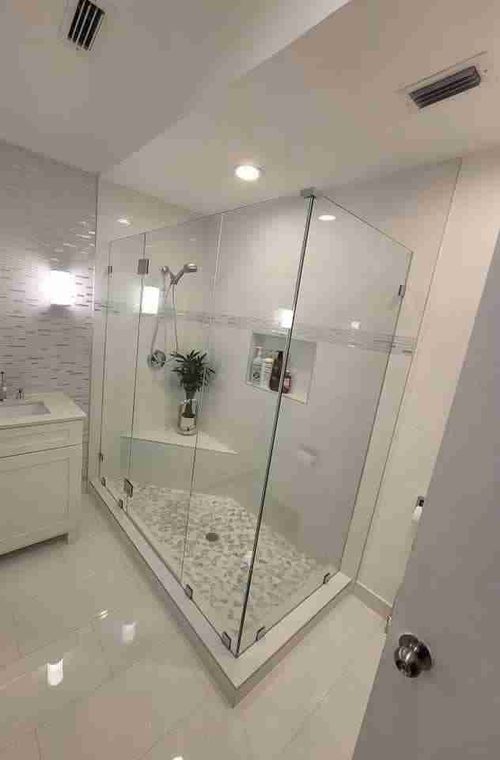
A corner enclosure is the most efficient way to fit a real glass shower into a tight bathroom. Two perpendicular glass walls meet at the 90° corner — one wall is fixed, and the other holds a swinging door. (When space allows, both walls can be fixed and a swinging door sits at the open end of one of them.)
The corner connection itself is the detail most installers get wrong. We detail it three ways depending on the look you want and how square your walls actually are: a clean clear-silicone seam, a slim brass or chrome 90° connector, or a precise butt-joint with a wet seal. All three are watertight when the field measure is done right.
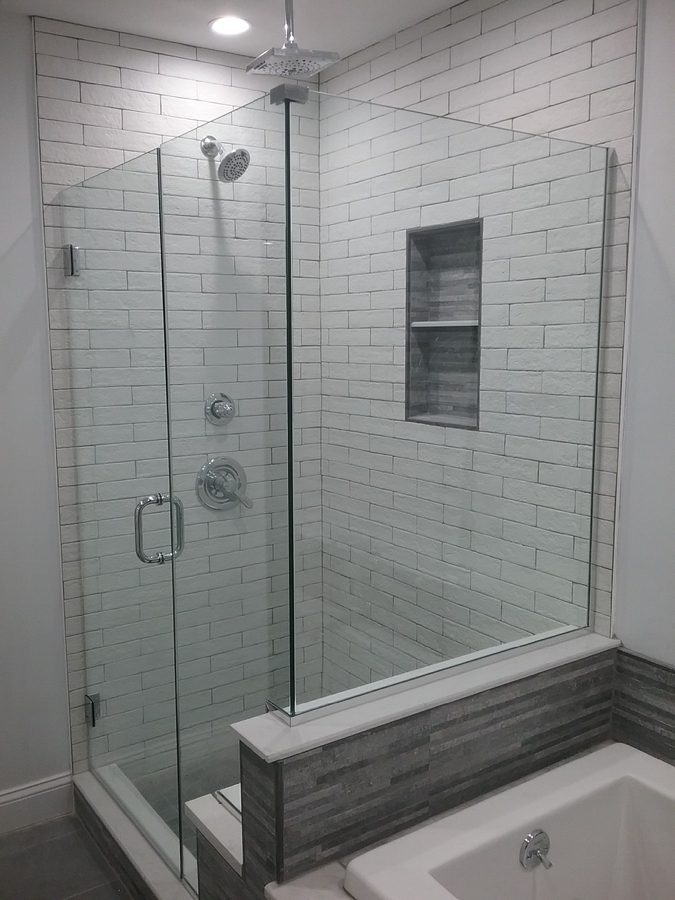
Bergen and Passaic counties are full of bathrooms that were never designed around a modern walk-in shower. Second-floor baths in 1920s–1960s homes in Hackensack, Paramus, Clifton, Garfield and Lodi all share the same problem: not much floor and a lot to fit on it. Same story in most condo bathrooms and in kids' baths where a vanity and linen tower have to go somewhere.
A corner enclosure is usually the right answer for those layouts. The shower tucks into the corner of the room and leaves the rest of the floor open for everything else. It's the difference between a bathroom that "works" and one that feels cramped every morning.
Worth knowing the difference: a corner enclosure is a 90° L-shape. A neo-angle shower is the related 5-sided shape with an angled door cutting across the corner — same general idea, more architectural. If you're not sure which one fits your room, send a couple of photos. We'll tell you straight, no upsell.
Ask Which Shape FitsA corner enclosure is a 90° L-shape — two glass walls meeting at a right angle in the corner of the room. A neo-angle is a 5-sided shape where two short side walls hold an angled door panel that cuts diagonally across the corner. Corner enclosures fit tighter spaces and read more like a regular shower; neo-angles take a little more floor space but look more architectural.
Frameless is absolutely an option, and it's what most of our Bergen and Passaic clients pick. We use 3/8" or 1/2" heavy tempered glass on both walls, with a slim header brace where the two panels meet for stability. Semi-frameless and framed versions exist too and can save a little money, but the frameless version is what gives a small bathroom the most open feel.
Not when it's detailed correctly. The two glass panels meet either with a clear silicone joint, a brass or chrome 90° connector, or a clean butt-joint with a wet seal. We field-template the corner so the panels are cut to the exact angle of your walls — which are rarely a perfect 90° in older NJ homes — and the seal does the rest.
We typically want at least 22″–24″ of clear door opening so the door can swing freely and you can comfortably step in and out. For very tight stalls, a smaller door with a return panel can work, or you can spec a sliding bypass on one face instead of a hinged door.
Most corner shower doors swing outward into the room — that's the safer default because nothing can block egress from inside the stall. With enough interior width, we can spec a pivot that swings both ways. Inward-only swing is rarely a good idea in a corner because the door bumps the opposite wall.
Cost varies with the size of both panels, glass thickness, hardware finish and whether you go frameless, semi-frameless or framed. We give you a firm, itemized quote after a free in-home measure — and offer monthly payment options so you don't have to choose between quality and budget. See our shower door cost guide for ballpark ranges.
A corner enclosure lives or dies on the corner joint. We use heavy tempered safety glass, premium hardware, precise field measurements that account for out-of-square walls, and our own in-house installation team. No subcontractors. No guesswork. No vague pricing. Just a corner enclosure built to fit your bathroom correctly the first time.
Most corner installs vary with panel size, glass thickness, hardware finish and the corner detail you choose. We give you a firm, itemized quote after a free in-home measure — and offer monthly payment options so you don't have to choose between quality and budget.
Tell us about your bathroom — we'll schedule your free in-home measure with no obligation, and you'll have a firm written quote in hand within a couple of days.
Call, text or fill out the form — we'll get back to you with a free estimate, typically within one business day.
Text Jessica directly and she'll get right back to you. To speed things up, include: