Quick answer: Thickness is chosen for the application and the look, not for taste. A protective top over a wood dining table is 1/4 inch. A coffee table or home-office desk is 3/8 inch. A freestanding glass dining table or vanity is 1/2 inch. A very large dining or conference top, or any piece where the glass is the design feature, is 3/4 inch. At every thickness, tempered glass is the spec for any load-bearing surface — and that covers nearly every application that isn't strictly protective.
This is the practical thickness chart we use on every job at our Lodi shop. Pair it with our full glass tabletops buyer's guide for the rest of the decisions (edge finish, shape, mounting), or jump to the at-a-glance chart below.
The thickness chart at a glance
Four thicknesses cover essentially every tabletop project we cut. Each step up roughly doubles the visual weight of the glass and adds 30–60 percent to the material cost.
| Thickness | Best for | Approx. weight (per sq ft) | Visual feel |
|---|---|---|---|
| 1/4″ (6mm) | Protective tops over wood, small side tables, glass shelves under 24″ span | 3.3 lbs | Light — nearly invisible |
| 3/8″ (10mm) | Coffee tables, home-office desks, smaller dining tables, longer shelves | 5.0 lbs | Substantial — the all-around favorite |
| 1/2″ (12mm) | Freestanding dining tables, executive desks, conference tables, vanity tops | 6.5 lbs | Premium — visible thickness from across the room |
| 3/4″ (19mm) | Very large dining and conference tables, statement pedestal pieces | 10.0 lbs | Dramatic — the glass becomes a design feature |
By far the most common thickness we cut is 3/8 inch — it lands at the sweet spot for residential coffee tables, desks and smaller dining pieces. 1/2 inch is the standard upgrade on any glass dining table and is non-negotiable on conference tables. 3/4 inch is rare but unforgettable when the design calls for it.
When 1/4″ is right
One-quarter-inch glass is the thinnest practical option for a tabletop application. Its job is almost always sacrificial — protecting a surface that already exists.
Protective tops over wood. The most common 1/4″ application. A thin sheet of annealed (or tempered, if budget allows) glass laid over an existing solid wood dining table, antique writing desk, or coffee table the homeowner wants to protect. The wood underneath is the actual structural surface — the glass just takes the abuse from drink rings, hot dishes, fingernails and stray pens. Bumper pads keep the glass from sliding and protect the finish.
Small side tables and accent pieces. A nightstand top, a small accent table next to a sofa, a plant-stand glass disc — anywhere the span is short (under 30 inches) and the load is light, 1/4 inch tempered is plenty. Lighter glass is easier to handle, less expensive, and visually disappears.
Display and built-in shelves. For shelves up to roughly 24 inches between supports, 1/4 inch tempered handles the span without visible deflection. Longer shelf spans need to step up to 3/8 inch or add a midspan support.
Where 1/4 inch is the wrong call: any freestanding tabletop where the glass is the surface. A 1/4″ glass coffee table top on a metal base will deflect under load, feels flimsy to the touch, and reads as a budget piece even when the rest of the room is high-end. Step up to 3/8 inch the moment the glass is doing structural work.
When 3/8″ is right
Three-eighths-inch glass is the all-around workhorse. It's the thickness we spec by default on coffee tables, home-office desks and smaller dining tables — anywhere a customer wants the glass to feel substantial without crossing into premium territory.
Coffee tables. The single most common 3/8″ application. A 48 by 24 inch or 60 by 30 inch coffee table top on a metal or wood base reads as a proper piece of furniture in 3/8″ glass. The thickness disappears visually at a glance but has real visual weight up close — exactly what most modern living-room designs want. A pencil edge or polished flat edge in 3/8″ is the modern-minimalist default.
Home-office desks. See our companion guide on custom desk glass for home offices for the full breakdown, but the short version: 3/8″ tempered handles a keyboard, two monitors and elbows-down working all day with no deflection and no visible wear over the years.
Smaller dining tables. For glass dining tables up to about 60 inches long, 3/8″ tempered is acceptable structurally and reads as light and contemporary. Larger than that and we step up to 1/2 inch — the visual weight at 3/8″ starts to look insufficient on a 72+ inch dining table.
Longer shelves. For shelf spans 24 to 36 inches, 3/8″ tempered is the right call.
When 1/2″ is right
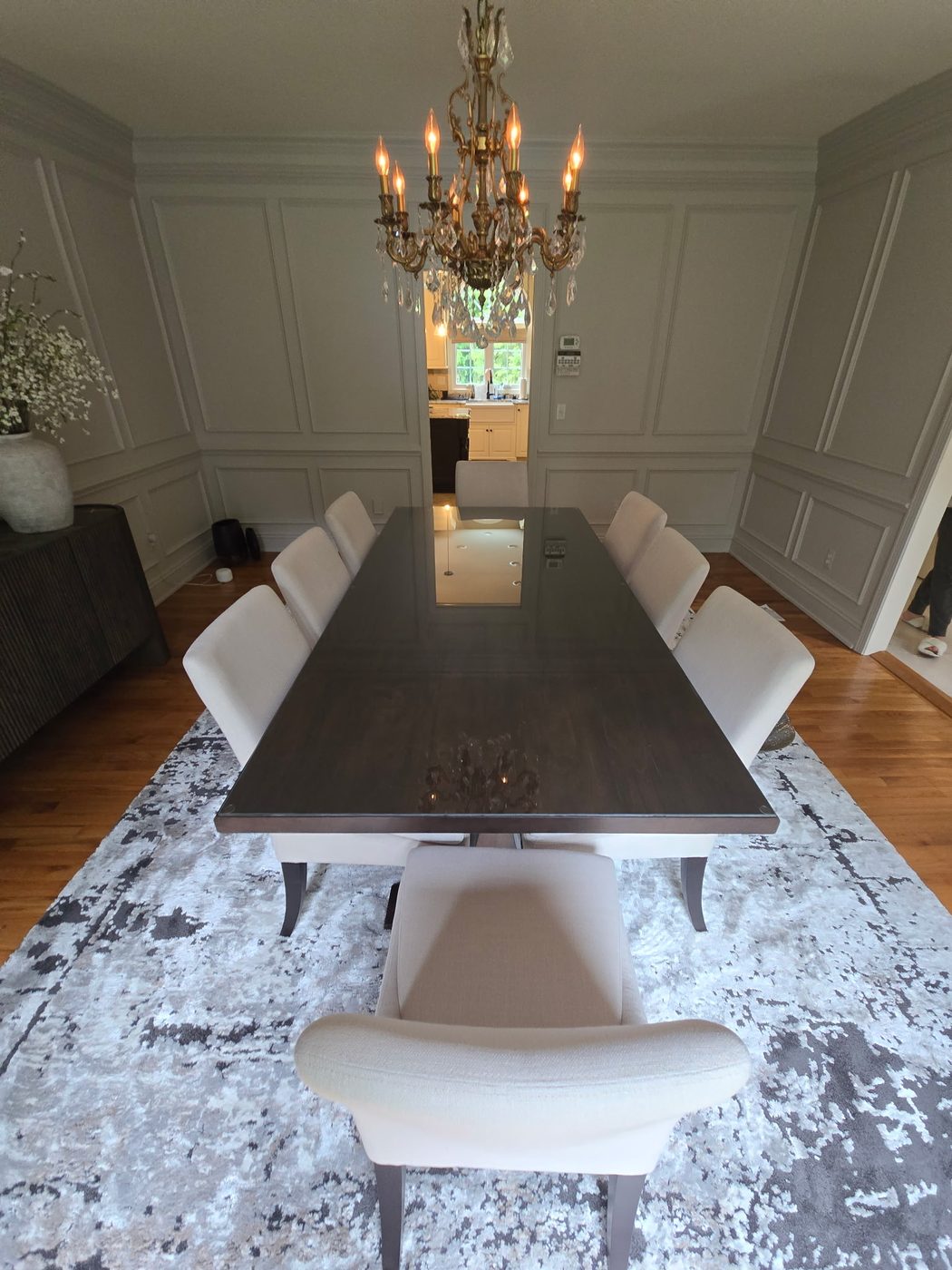
Half-inch glass is the standard for any tabletop where the glass is the primary surface and the table is in regular daily use. It's the baseline thickness for freestanding glass dining tables, executive desks and conference tables.
Dining tables. Any glass dining table 60 inches or longer should be 1/2 inch as the baseline. The visual weight matches the scale of the piece, and the structural margin handles years of dishes, elbows and family use without measurable deflection. Round dining tables 54 inches and up are also 1/2 inch.
Executive desks. Larger desks (66 inches and up) and any desk where the glass is meant to look premium step up from 3/8″ to 1/2″. The visible thickness from across an office reads as more substantial.
Conference tables. Most residential conference tables up to 120 inches long are 1/2 inch tempered. The thickness handles the span on a typical two-pedestal or trestle base without visible flex.
Vanity tops. Bathroom vanity tops in glass — typically frosted or back-painted on the underside — are 1/2 inch or 3/4 inch. The added thickness matters here because the glass cantilevers past the cabinet face and supports a vessel sink or hardware.
Weight check: A 96 by 42 inch dining table top in 1/2 inch tempered glass weighs about 185 pounds. That's a confirmed two-person carry on delivery — and worth thinking about for any future room rearrangement.
When 3/4″ is right
Three-quarter-inch glass is the dramatic, statement-piece thickness. It's overkill for structure on almost every residential application — but the visual weight is the point. When a designer or homeowner wants the glass itself to read as a single thick slab, 3/4 inch is the call.
Very large dining tables. Dining tables 96 inches and longer, especially on pedestal or trestle bases where the glass cantilevers significantly past the base, are candidates for 3/4 inch. The added thickness shows from across a room and signals furniture-grade quality.
Large conference tables. Conference tables 12 feet and longer typically step up to 3/4 inch — or are built as two-panel seamed tops with butt joints or stainless connectors.
Statement furniture. The occasional residential piece — a glass-on-glass coffee table, a single-slab living-room centerpiece, a designer-spec'd accent — is 3/4 inch for the look.
The trade-offs at 3/4 inch are real. The material costs noticeably more than 1/2 inch per square foot. The weight is significant: a 96 by 42 inch 3/4 inch top weighs about 280 pounds, at least a three-person carry, and may require a glass-rack delivery truck rather than a standard van. The base must be rated for the load. And the order has to be planned around the tempering lead time (3/4 inch tempered is usually 7–12 business days). When the design calls for it, all of that is worth it. When it doesn't, 1/2 inch is the right call.
Weight, by the numbers
Glass weighs roughly 3.3 pounds per square foot per 1/4 inch of thickness. That math lets you estimate any tabletop's weight before you order:
| Top size | 1/4″ | 3/8″ | 1/2″ | 3/4″ |
|---|---|---|---|---|
| 48″×24″ (8 sq ft) | 27 lbs | 40 lbs | 53 lbs | 80 lbs |
| 60″×30″ (12.5 sq ft) | 42 lbs | 62 lbs | 82 lbs | 125 lbs |
| 72″×36″ (18 sq ft) | 60 lbs | 90 lbs | 120 lbs | 180 lbs |
| 96″×42″ (28 sq ft) | 93 lbs | 140 lbs | 185 lbs | 280 lbs |
| 120″×48″ (40 sq ft) | 132 lbs | 200 lbs | 265 lbs | 400 lbs |
Two practical implications. First, the base has to be rated to hold the glass; most quality bases handle 200–300 pounds comfortably, but light decorative bases can be a problem. Second, delivery requires two people for anything over about 80 pounds, three for anything over 200, and our delivery crew is set up for it — but it's worth confirming someone is available on your end to help us position the top.
Safety: why tempering matters at every thickness
Tempered glass is heat-strengthened to roughly four times the impact resistance of standard (annealed) glass. If it ever breaks, it crumbles into small blunt pieces — not the long sharp shards that annealed glass produces. For any tabletop that serves as a load-bearing surface, tempering is the spec at every thickness.
That includes 1/4 inch shelves in a built-in (tempered), 3/8 inch coffee tables (tempered), 1/2 inch dining tables (tempered) and 3/4 inch conference tops (tempered). The only application where annealed is acceptable is a protective layer over an existing solid surface — and even there, many homeowners spec tempered for peace of mind.
Practically, tempering adds 2–3 days to fabrication (the tempering itself happens in an oven at an outside facility) and roughly 30–50 percent to the base cost of the glass. It also means the spec has to be locked in before tempering — tempered glass cannot be cut, drilled or edged after the temper. Every dimension, every hole, every edge profile is finalized on the shop ticket before the glass goes through the oven.
Cost by thickness
Thickness is the single biggest cost lever after total square footage. Using a 48 by 24 inch tempered tabletop with a pencil edge as a benchmark:
- 1/4″ tempered: $200 – $300
- 3/8″ tempered: $300 – $450
- 1/2″ tempered: $475 – $700
- 3/4″ tempered: $850 – $1,300
The same top in annealed (where allowed — protective applications only) is 30–50 percent less than the tempered price. Larger tops scale with material cost; very small tops have a shop minimum.
Not sure which thickness you need?
Tell us the application and the dimensions and we'll spec the right thickness — usually with a written quote back the same business day. Free in-home measure available across Bergen, Passaic, Hudson and Essex counties.
Get a Free QuotePutting it all together
Thickness is a small decision with a big effect on how the finished piece looks and feels. The default cascade we recommend: protective over wood? 1/4 inch annealed. Coffee table or home-office desk? 3/8 inch tempered. Dining table or executive desk? 1/2 inch tempered. Very large or statement piece? 3/4 inch tempered. Each step up is a real change — substantial enough to feel different to the eye and the hand — and each step up has cost and weight implications worth knowing about before you order.
For the full set of decisions on a custom tabletop (shape, edge finish, mounting, lead time), see our pillar guide on glass tabletops in NJ. For the service page itself, see tabletops. And if you want a hand picking the right spec for your project, call Jessica at (201) 460-1313 — we'll talk through the application and recommend the thickness that fits.