
Most of our care-and-maintenance posts focus on shower glass — and for good reason, because shower glass faces the harshest daily environment of any glass in your home. But the same homeowners who ask great questions about shower-door care often miss the much simpler routine that keeps glass railings and tabletops looking new for decades. This post is the focused guide for those two surfaces — what they actually need, what they don't, and what to never do.
For broader context, see our year-round glass care pillar. For specific service pages, see glass railings and glass tabletops.
Why these surfaces are different from shower glass
Shower glass faces three relentless enemies: hard water, soap residues, and persistent humidity. Without daily intervention, those three combine to etch glass within a year or two in North Jersey.
Glass railings and tabletops face a different mix:
| Surface | Main contaminants | Cleaning intensity |
|---|---|---|
| Indoor glass railing | Fingerprints, hand oils, pet noses, dust | Low — weekly wipe |
| Outdoor glass railing | Pollen, dust, bird debris, rain spotting | Low-medium — monthly + seasonal rinses |
| Glass tabletop (dining) | Food residue, hand oils, wine, finger marks | Medium — after each meal + weekly deep wipe |
| Glass tabletop (coffee/side) | Hand oils, dust, occasional ring marks | Low — weekly wipe |
| Pool-deck railing | Pool chemistry vapor, splash, sunscreen residue | Medium — monthly + hardware focus |
The common thread: none of these surfaces have the daily hard-water deposit problem that shower glass has. So the routine is mostly about removing what's been touched or what's landed on the glass, not about dissolving stubborn mineral buildup. The chemistry is simpler. The frequency is lower. The risk of damage from harsh cleaners — same as on shower glass.
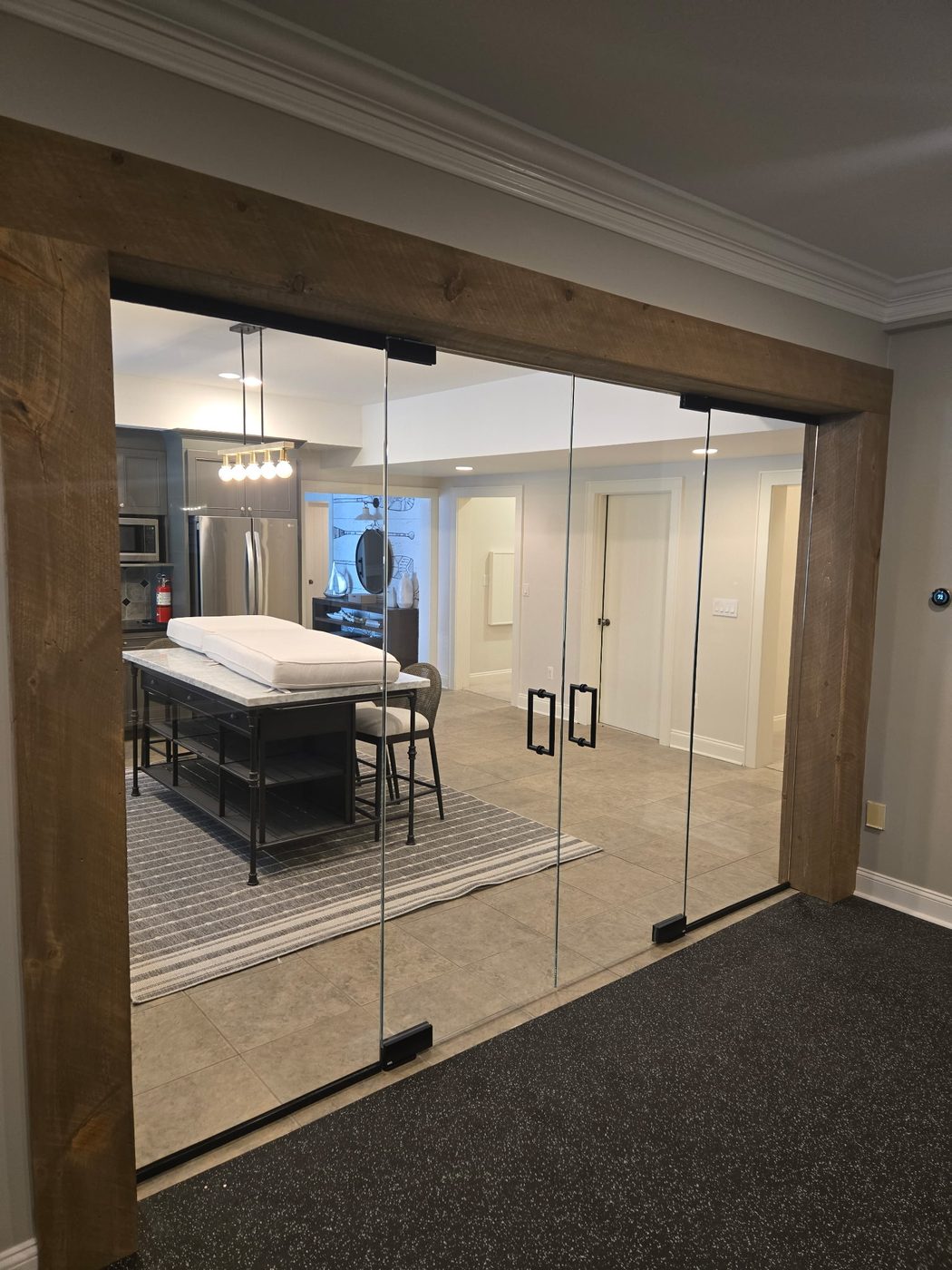
Indoor glass railings: the weekly routine
Indoor glass railings (stairwells, mezzanines, lofts, balcony walls) get touched constantly — handprints, dust, and in homes with pets or kids, plenty of nose-and-fingerprint art at the lower 18 inches. A simple weekly routine keeps the glass looking installed-yesterday.
What you need
- Two clean microfiber cloths
- pH-neutral glass cleaner OR a 1:1 vinegar-and-water spray bottle
- Cotton swabs for tight corners around standoff connectors
The process
- Spray the cleaner onto a microfiber cloth, not directly onto the glass. Direct spraying lets overspray pool at the base channel where it can attack the hardware.
- Wipe both sides of each panel in straight horizontal then vertical strokes.
- Use a cotton swab dipped in cleaner to get into the corners around stainless connectors, where fingertips can't reach.
- Buff dry with the second microfiber for streak-free finish.
- Inspect each standoff for any looseness in the wood handrail attachment — this is the one structural item worth checking weekly while you're already at the railing.
Total time for a typical indoor railing: 10–15 minutes once a week. For households with multiple dogs at the lower panels, a daily quick microfiber pass on the bottom 18 inches keeps the worst of it under control.
Outdoor glass railings: the seasonal routine
Outdoor railings (decks, patios, pool decks, balconies) face UV, pollen, wind-driven dust, occasional bird visits, and storm spray. The good news: they don't need much.
Monthly process (May–September)
- Hose-rinse first to flush off loose debris. A thumb-spray nozzle is enough pressure.
- Wipe both sides of each panel with a microfiber on a long-handled mop, using a pH-neutral outdoor glass cleaner or vinegar-water.
- Pay extra attention to the base channel where dirt accumulates — wipe along the bottom edge with a folded microfiber.
- Buff dry with a clean microfiber or squeegee.
Quarterly process (year-round)
- Inspect every standoff or post fitting for any looseness or corrosion.
- Check the base channel seal (the line where the glass meets the floor/deck) for any gaps or water-pooling.
- For coastal-influenced towns (Edgewater, Cliffside Park, Fort Lee, anywhere with Hudson breezes) — give the hardware a fresh-water rinse and dry, salt-air corrosion is real but slow.
Pollen-season tactic (April–June, August–September)
NJ pollen surges produce visible yellow film on outdoor glass within days. A quick hose rinse weekly during these windows keeps the glass clear — no detergent needed, just water. If pollen is allowed to bake in the sun for weeks, it can leave a faint residue that takes a more thorough cleaning to lift.
Storm-cleanup tactic
After a heavy thunderstorm — common all summer in North Jersey — outdoor glass gets a mix of windblown grit and rain spotting. A hose rinse within 24 hours flushes the grit off before it gets ground into the surface by daily handling.
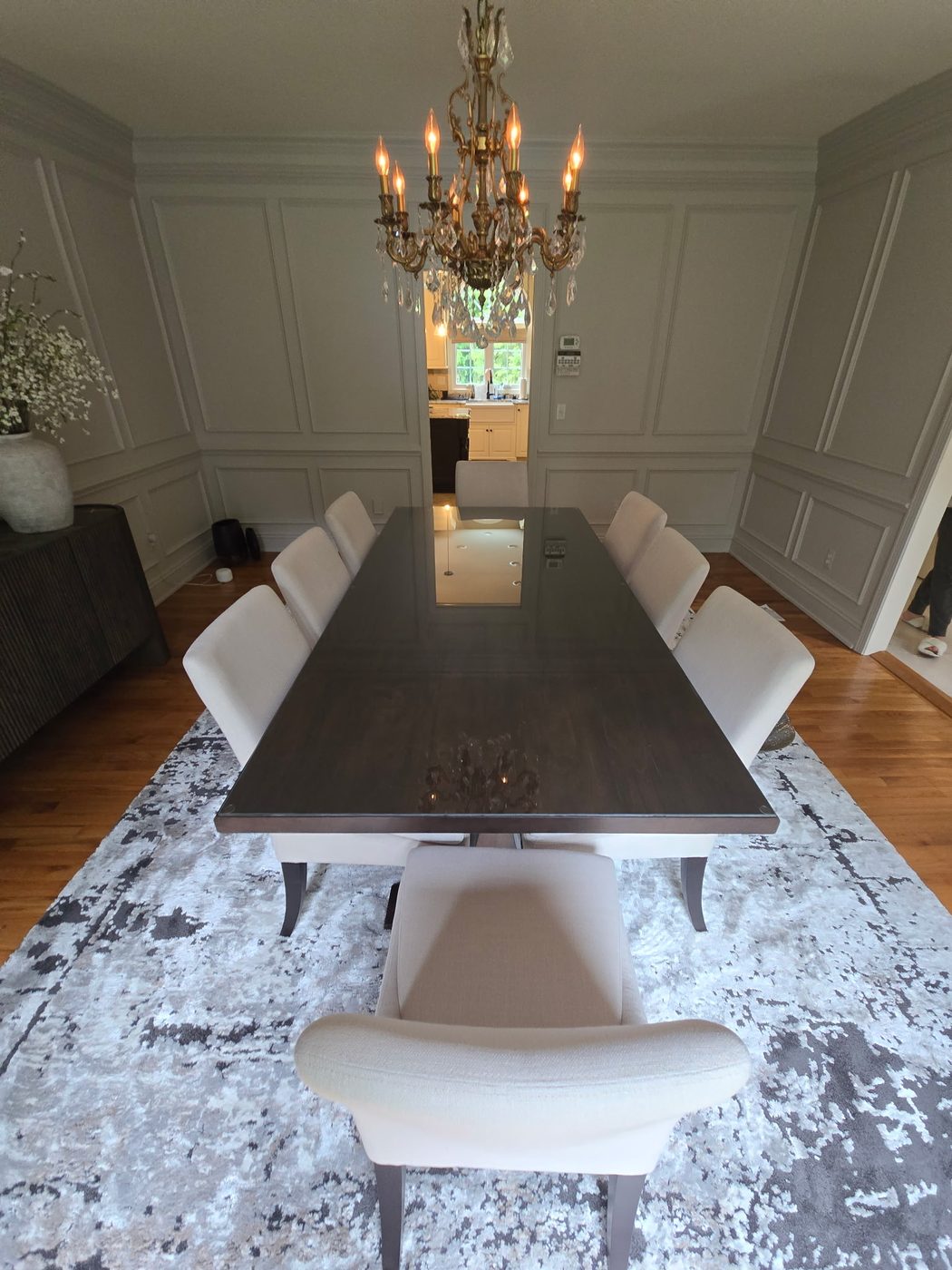
Glass tabletops: the meal-by-meal routine
Glass tabletops, especially dining tables, get the most direct daily contact of any glass in your home. Hands, plates, glasses, food spills, wine, sauces. The routine is simple but consistent.
After every meal
- Clear the table completely.
- Spray a pH-neutral glass cleaner onto a microfiber (not on the glass) and wipe in straight strokes.
- Buff dry with a clean microfiber.
Weekly deep wipe
- Clear the entire top.
- Inspect the perimeter — any chips at the edges are a warning sign for future tempered-glass failure. (See our post on fixing minor scratches in glass and mirrors for the chip rule.)
- Vinegar-water dwell on any sticky spots (sauce, wine, fingerprint clusters) for 5 minutes.
- Full surface wipe with pH-neutral cleaner and microfiber.
- Buff dry.
For greasy residue specifically
Greasy food residue doesn't dissolve well in pH-neutral cleaner alone. Apply diluted dish soap on a damp microfiber first, wipe in circles to lift the grease, then follow with a pH-neutral cleaner wipe to remove soap residue and finish streak-free. Avoid degreasers near hardware on glass tables that have metal supports.
Coffee and side tables
Lower-traffic glass tabletops need much less — a weekly microfiber wipe with pH-neutral cleaner is plenty. Watch for ring marks from wet glasses (the same calcium-magnesium chemistry as shower glass, in miniature) — wipe these promptly before they dry rather than letting them build up.
What to never use (the cheat sheet)
The list of things to avoid is the same across all custom glass surfaces, plus a few specific to outdoor railings.
| Use freely | Avoid entirely |
|---|---|
|
|
Pet noses and small hands: the most common question
Households with dogs and young kids ask about this constantly. The answer is simpler than you'd think.
For dogs: spray a pH-neutral cleaner onto a microfiber, wipe in straight strokes, done. No dwell needed because pet noses don't deposit mineral content — just oils and saliva. A daily quick wipe of the bottom 18 inches prevents accumulation; for most homes, a weekly cleaning catches it without daily attention.
For kids: same approach for handprints. For sticky residue (juice, candy), a 30-second vinegar-water dwell before wiping makes it easier.
For both: microfiber cloth in a kitchen drawer or laundry-room hook, ready to grab. The biggest factor in keeping railings looking good in pet-and-kid households is making cleanup easier than ignoring it.
Hardware: the inspection that prevents big problems
The glass itself is almost permanent. The hardware on glass railings and the supports on glass tabletops — clips, standoffs, brackets, post fittings — are the wear point. Quarterly inspection catches small issues before they become structural.
For glass railings
- Wiggle each standoff or post connector gently. Any looseness should be tightened with the proper allen key — a 5-minute job. Loose hardware accelerates wear on the panels because they begin to flex with every contact.
- Check the base channel for any gaps, water pooling, or sealant breaks. Sealant gaps can let water reach the structural attachment beneath.
- Inspect for corrosion on stainless fittings — especially near pools or in coastal-influenced areas. Surface corrosion (light brown spotting) can be polished off; deep pitting means hardware replacement.
For glass tabletops
- Inspect the perimeter for chips at the edges. Any chip in tempered glass is a warning sign for catastrophic failure — see our post on fixing minor scratches in glass and mirrors for the chip rule in detail.
- Check the supports for any looseness — a wobbling tabletop puts uneven stress on the glass.
- Look at the suction/grip pads or felt buffers where the glass meets the supports. Replace any that have worn down or hardened, as the glass should not be in direct rigid contact with metal supports.
If anything looks off during inspection, send us a photo. Most railing-hardware issues are fixable with a brief service call. Tabletop support replacements are typically straightforward.
Loose hardware or a chipped edge?
Send Jessica a photo. Hardware tightening, gasket replacement, and damaged-panel quotes are usually returned same day, and most service calls in Bergen, Passaic, Hudson and Essex counties are scheduled within a week.
Text Jessica a Photo →
Seasonal cleaning calendar for NJ railings and tabletops
For homeowners who want a single page to reference, here's the year on one schedule.
| Season | What to do | Why |
|---|---|---|
| Spring (Mar–May) | Deep clean indoor railings and all tabletops; pollen-rinse outdoor railings weekly | Reset for the year; address tree-pollen surge |
| Summer (Jun–Aug) | Monthly outdoor railing wipe; quarterly hardware inspection; after-storm rinses | Peak outdoor exposure |
| Fall (Sep–Nov) | Ragweed-pollen rinses on outdoor; pre-winter hardware tightness check on railings | Catch loose hardware before winter |
| Winter (Dec–Feb) | Indoor focus — dust frequency is higher with closed windows; railings near cold exterior windows may need extra attention | Closed-house indoor air carries more particulate |
When to call AGM
For routine cleaning, this guide is everything you need. Call or text us when:
- A railing standoff is loose and tightening doesn't hold — hardware service.
- A glass railing panel has any chip, crack, or visible damage — replacement (safety priority on guardrails).
- A tabletop has any chip at the edge — schedule a replacement before failure.
- Outdoor railing hardware shows corrosion deeper than light surface spotting.
- You're seeing any cloudiness or haze that doesn't wipe off — rare on railings and tabletops, but possible with neglect.
- You want to add a hydrophobic coating to outdoor railings to reduce pollen and rain spotting.
For more on care across all custom glass surfaces — including the shower-specific deep dives — see our glass shower care guide and the year-round glass care pillar.
Have an outdoor railing collecting pollen and rain spotting?
A hydrophobic coating on outdoor glass railings dramatically reduces both — and stays effective for several years. Ask Jessica about coating service for railings, not just showers.
Get a Coating Quote