
The single most valuable preventive upgrade for North Jersey glass is a professional hydrophobic coating. The chemistry is simple: a fluorinated or silane-based compound bonds to the silica surface of the glass and dramatically lowers its surface energy. Water can't wet the glass, so it beads up and rolls off — taking most of the mineral content with it. With a coating in place, hard-water spotting, soap-scum buildup, and the daily care burden all drop sharply.
The coating doesn't last forever. After 3–5 years of daily showers, it depletes, and the glass starts behaving like uncoated glass again. This post is the focused deep dive on coating reapply — when to do it, how to spot the signs, and what a professional reapply involves. For broader care context, see our year-round glass care pillar, and for the service page itself, see protective glass coating in NJ.
How long does the coating actually last?
The honest answer is "it depends." But here's how the typical North Jersey lifespan breaks down:
| Coating type | Typical lifespan | What affects it |
|---|---|---|
| Factory-applied coating (new enclosure) | 4–7 years | Bonded under controlled manufacturing conditions; longest lifespan |
| Professional reapply (existing glass) | 3–5 years | Depends on surface prep quality and ongoing care |
| Retail DIY spray-on | 2–12 weeks | Lower-concentration polymer, no acid prep, no bonding cure |
Variables that shorten the lifespan in any tier: a household with daily showers by multiple people, very hard well water (200+ mg/L), use of abrasive cleaning products, and use of razor blades or harsh degreasers on the coated glass. Variables that extend it: consistent squeegeeing, weekly pH-neutral wipes, and using only the appropriate cleaners.
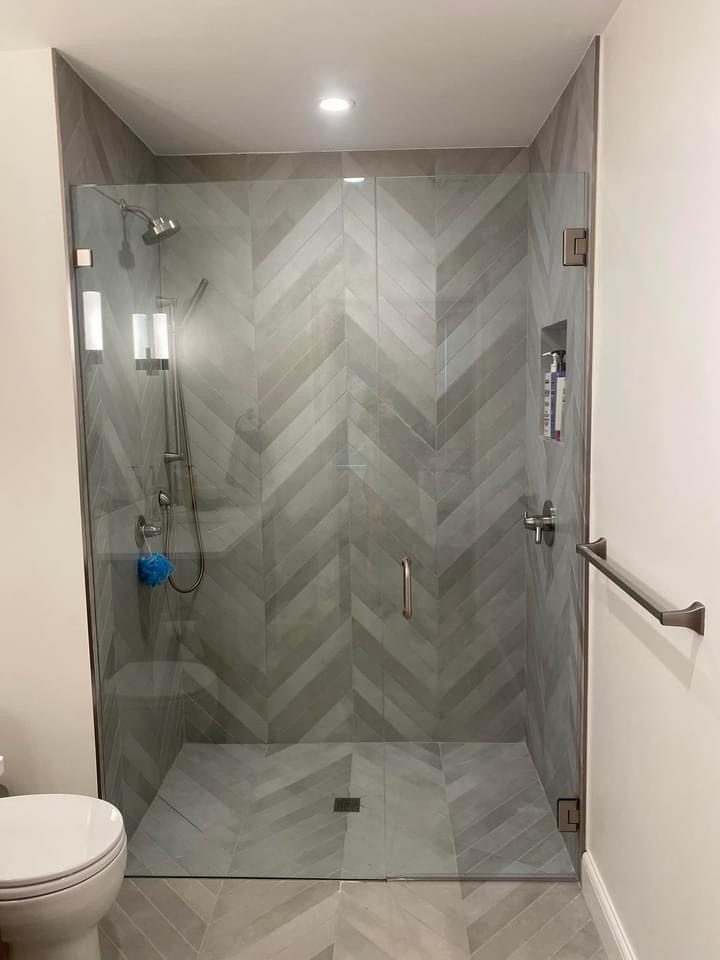
Signs your coating is wearing off
The transition isn't abrupt — coatings degrade gradually. Here's what to watch for, roughly in the order they appear.
Sign 1: water beads less aggressively
This is the earliest and most reliable indicator. Fresh coating produces water beads that look almost like mercury — round, glossy, and rolling off the glass on the slightest slope. Worn coating still produces beads, but they're flatter, slower, and start sheeting where the coating has thinned. Watch this during your next shower: how does water behave on the glass? If it beads visibly less than it did a year ago, the coating is depleting.
Sign 2: soap scum starts sticking again
If you've been showering for 3–4 years with the glass staying remarkably clear despite hard water and you're noticing film for the first time, the coating is the cause. With a fresh coating, soap scum can't build because it can't dry on the glass. Once the coating wears out, soap scum returns as if the glass had never been coated.
Sign 3: mineral spotting on glass you squeegee
If you're squeegeeing diligently and still seeing spotting return, the coating isn't doing its part. Squeegeeing removes most water but not all — the rest evaporates. On coated glass, the residual water doesn't dry as deposits because the surface is hostile to wetting. On worn-out coating, those residual droplets deposit minerals just like any uncoated glass.
Sign 4: the glass starts to feel different
A more subjective indicator: coated glass feels noticeably smooth and slightly slippery when wet. Wear that out and the glass starts to feel like ordinary uncoated glass — drier, more textured under wet fingertips.
If you're seeing two or more of these signs, your coating is at the end of its life and a reapply will restore the original performance.
Use vs. avoid: how to make the coating last
| Use freely | Avoid entirely |
|---|---|
|
|
The single behavior that most reliably shortens coating life is using a razor blade to remove dried-on residue. One pass with a blade strips the coating completely in a strip — and once a strip is gone, water sheets there and minerals start depositing locally even while the rest of the glass still beads. If you find yourself reaching for a razor blade, that's the signal to text us about a reapply instead.
DIY retail kits — what they actually are
Hardware stores sell various hydrophobic spray-on glass treatments. They exist on a different durability tier than what we apply.
| Property | Retail DIY spray | Professional reapply |
|---|---|---|
| Chemistry | Lower-concentration polymer or silicone | Fluorinated silane or higher-grade hydrophobic compound |
| Surface prep | Wipe-down only | Acid prep, deep clean, controlled drying |
| Application | Spray and wipe; minutes | Multi-step bonding cure; an hour or more per enclosure |
| Lifespan | 2–12 weeks | 3–5 years |
| Use case | Bridge between professional applies | Multi-year solution |
Retail kits aren't useless — they can extend the life of a slightly-worn coating by a few weeks while you schedule a professional reapply, and they're cheap insurance for a guest bath that doesn't see daily use. But they're not a substitute for the real thing. The chemistry, the surface bond, and the time-to-cure are different.
What a professional reapply involves
Here's the process when we come out to reapply coating on an existing enclosure.
Step 1: deep clean
Before any new coating goes on, the glass has to be completely free of soap residue, mineral film, and existing-coating remnants. We do a vinegar-water deep clean, followed by a baking-soda paste if there's significant buildup, and a final clear-water rinse. On heavily etched glass, we may also do a light cerium-oxide polish to restore surface optical quality before coating — this is judgment-call territory and we discuss it on-site.
Step 2: acid prep
A controlled acid prep activates the silica surface of the glass so the new coating can bond chemically rather than just sitting on top. This step is what distinguishes a professional coating from a DIY spray. The acid has a brief sharp odor; we ventilate the bathroom during the prep.
Step 3: dry to controlled humidity
The coating chemistry bonds best on a surface at controlled humidity. We blow-dry or wait for the bathroom to reach the right state before application — typically 10–20 minutes depending on conditions.
Step 4: coating application
The hydrophobic compound is applied in even passes across the entire surface, including the inside, outside, and any return panels. We avoid hardware and gasket areas. Two coats with a brief cure between produces the longest-lasting result.
Step 5: cure time
The coating needs to cure undisturbed for several hours. We typically tell homeowners not to shower in the enclosure for 24 hours, though incidental water (hand washing nearby) is fine after 4–6 hours.
Total appointment time is 60–90 minutes for a standard enclosure, plus the 24-hour cure window. Two-person households should plan around an alternative shower or wash up overnight; for larger homes the secondary bathroom usually carries the day fine.
Cost vs. replacement
A professional reapply costs a small fraction of replacing the enclosure entirely. The exact pricing depends on size, existing condition, and whether a deep restoration clean is needed first. We provide a flat-rate quote after seeing photos.
The reapply makes sense whenever the glass itself is in good optical condition. If the glass is already heavily etched — fingerprint-test rough, deep cloudiness that survives every cleaning attempt — coating restoration alone won't bring back optical clarity, and we'll discuss whether a single panel replacement or a new enclosure is the better long-term value. Either way, we tell you straight.
Ready for a coating reapply quote?
Send Jessica a couple of photos of your enclosure — including a close-up where you can see how water behaves on the glass. We'll quote a reapply, and if the glass needs more than coating, we'll tell you that too.
Text Jessica a Photo →
The coating-and-care system
A coating isn't a substitute for care — it's a force multiplier on care. The full system for North Jersey glass:
- Squeegee after every shower. Coating reduces what dries, but doesn't eliminate it. The squeegee still matters.
- Weekly pH-neutral wipe. Even coated glass benefits from a weekly maintenance wipe.
- Avoid abrasives and razors. These shorten coating life from years to months.
- Reapply every 3–5 years. Like other consumables — sweep seals, water-heater anodes — the coating is on a predictable refresh schedule.
That stack handles essentially everything North Jersey water and use can throw at your glass. Without the coating, you can still keep glass clear with daily squeegeeing and weekly wiping — but the workload is meaningfully higher and the margin for missed days is smaller. The coating is the upgrade that makes the daily routine forgiving.
For broader context on how the coating fits into the full care year, see the year-round glass care pillar. For the daily and weekly habits in detail, see our glass shower care guide. And if you're seeing mineral buildup on coated glass that's a few years old, the post on removing soap scum covers the deep-clean before a reapply.
When to call AGM for coating service
Reach out when:
- It's been 3–5 years since the last coating was applied (or since the enclosure was installed if it came with factory coating).
- Water no longer beads aggressively on the glass.
- Soap scum is sticking for the first time in years.
- You bought a home with an existing enclosure and want to add a coating it never had.
- You had coating applied by another shop and the lifespan was disappointing — we can advise on whether the product or the use case was the issue.
- You're not sure whether the haze on your glass is wearing-off coating or something else.
Most coating service calls in Bergen, Passaic, Hudson and Essex counties are scheduled within a week. Photos sent to Jessica usually get a quote back the same business day.
Don't have coating yet on your enclosure?
If your shower glass was installed without a hydrophobic coating, we can apply one to most existing enclosures — AGM-installed or not. It's the single best upgrade for North Jersey hard water and it pays for itself in care-time savings inside a year.
Get an Initial Coating Quote