Quick answer: Custom desk glass falls into two categories. Protective tops are thin (1/4 inch) sheets of glass laid over an existing wood, laminate or metal desk to protect the surface from years of keyboard, mouse and wrist wear. Full glass desk tops are 3/8 inch or 1/2 inch tempered glass on a metal or wood base — the glass is the desk surface. Cable pass-through holes, monitor arm cutouts, and floating monitor shelves are all spec'd at fabrication before tempering.
This guide covers both — what to choose, how to spec it, and what to expect on cost and lead time. For thickness specifics in any tabletop application, see our thickness guide. For the full pillar on glass tabletops, see glass tabletops in NJ.
Why custom glass on a home-office desk?
Working from home went from temporary to permanent for a lot of North Jersey households, and the desk gets used hard — eight or ten hours a day, every day, often in a room that doubles as a guest room or a kid's homework station at night. Three things consistently happen to a wood or laminate desk under that kind of use:
- Keyboard and mouse wear. The corners and edges of a keyboard, the foot of a mouse, the contact points of a wrist rest all leave faint polishing marks on a wood finish within a few months. After a year or two the finish is visibly dull in the work zone.
- Drink rings and condensation. Coffee mugs, water glasses, an open soda — every one of them eventually leaves a ring on a wood surface, especially during summer when condensation drips off a cold glass.
- Random everyday damage. Pen marks, scissor scratches, the corner of a laptop dock that gets dragged across the surface, hot mugs set down without a coaster.
A glass top — protective or full — eliminates all of it. The surface stays pristine, cleans up in seconds with a microfiber cloth, and looks the same after five years as it did the day it was installed.
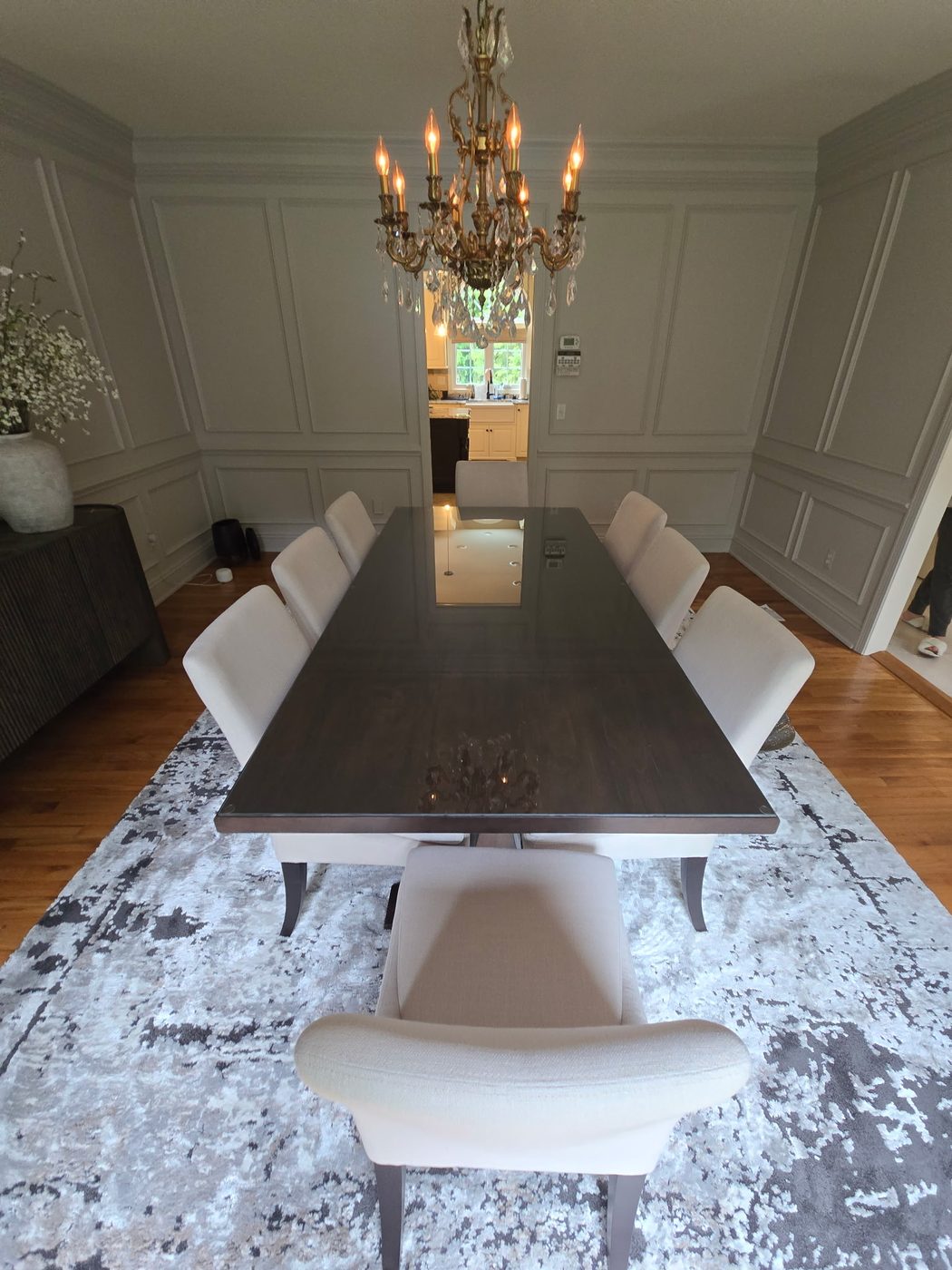
Protective top vs full glass desk: which is right?
The first decision is whether the glass goes over a desk you already have, or replaces the desk surface entirely. The two paths look the same from above but spec out very differently.
| Spec | Protective top | Full glass desk |
|---|---|---|
| Thickness | 1/4″ (sometimes 5/16″ or 3/8″) | 3/8″ standard, 1/2″ for executive desks |
| Glass type | Annealed or tempered | Tempered required |
| Cost (60″ desk) | $200 – $400 | $400 – $700 |
| Holes & cutouts | Drilled (annealed) or pre-drilled (tempered) | Drilled at fabrication, before tempering |
| Edge | Pencil or polished flat — soft to the forearm | Pencil or polished flat — soft to the forearm |
| Mounting | Bumper pads only — sits on top of the existing desk | Suction cups or drilled-and-bolted to the base |
| Lead time | 3–5 business days (annealed) | 7–10 business days (tempered) |
Protective tops are by far the more common ask. Customers like the desk they already own — often a real piece of furniture they don't want to replace — and they just want the surface preserved against years of work. The glass takes the damage; the wood stays factory-new underneath.
Full glass desk tops come up most often during a home-office build-out (a new desk frame from a furniture maker or DIY metal base, finished with a glass top) or when the existing desk is past its useful life and the customer wants a clean contemporary replacement.
Protective tops over wood, laminate or metal
A protective top is a piece of 1/4 inch glass cut to the exact dimensions of the existing desk surface, with finished edges, laid over the top. The glass sits on a few small bumper pads (typically four to six clear silicone discs about 1/8 inch thick) that prevent direct contact with the finish and add lateral grip so the glass doesn't slide.
Annealed (standard) glass is acceptable for protective tops because the desk underneath is the actual structural surface. If the glass ever broke, the desk is still there. That said, more customers are choosing tempered for protective tops too — it's about 30–50 percent more expensive but adds a meaningful safety margin, especially in family homes where the desk might double as a homework station.
Measuring a protective top. Either bring the desk to our Lodi shop for templating, or trace the top onto a piece of paper or cardboard at home and bring (or photo and send) the template. For rectangular desks, measure length and width in three places on each axis and use the smallest measurement — most desks are not perfectly square, especially older or hand-built pieces. For irregular shapes (an L-desk, a curved-front piece, a U-shaped configuration), a paper template is the most reliable method.
Overhang. A protective top can sit flush with the desk edge or overhang by up to about 1/2 inch on each side. Flush is the cleaner look on a modern desk; a small overhang is forgiving on older furniture where the desk edge isn't perfectly straight.
Holes and cutouts in protective tops. If the existing desk already has cable grommets or monitor-mount cutouts, the glass can be drilled to match. Annealed glass can be drilled relatively quickly during fabrication; tempered protective tops need the holes spec'd before tempering.
Full glass desk tops
A full glass desk top is a piece of 3/8 inch or 1/2 inch tempered glass on a metal, wood or pedestal base. The glass is the desk surface, so tempering is required (the desk is load-bearing) and the thickness is sized to feel substantial and structurally robust.
Standard sizes. Most home-office glass desks run 48 by 24 inches up to 72 by 36 inches. Executive home offices step up to 72 by 36 or 84 by 42 inches, and the occasional U-shaped configuration uses two or three glass panels meeting at the corners. Round and oval desk tops are uncommon but possible.
Thickness. 3/8 inch is the standard for most home-office desks and is what we spec by default. The glass feels substantial under the wrists, holds two monitors and a laptop dock with no measurable deflection, and reads as a proper piece of furniture rather than a thin sheet on legs. 1/2 inch tempered is the upgrade for executive desks (72 inches and up) and for any desk where the customer wants more visible weight from across the room.
Edges. Pencil edge is the right call for nearly every desk — softly rounded on the top and bottom, comfortable against the forearms during long working sessions. Polished flat edge is a slightly more architectural alternative for very modern offices. Beveled and ogee edges are uncommon on desks because the chamfered facet can catch wristwatches or shirt cuffs during typing.
Bases. Glass desk tops typically sit on a metal frame (steel, aluminum, or powder-coated tube), a wood base (maple, walnut, or oak panels with steel-rod connectors), or a pair of pedestal cabinets with the glass spanning across. Suction cups hold the glass in place against lateral movement; bumper pads cushion the contact. For a permanent install, the glass can be drilled and bolted to the base.
Cable management cutouts
Cable pass-through holes are one of the most common requests on home-office desk glass. The standard cutout is a 2-inch or 2.5-inch diameter hole drilled in the rear of the top, sized to accept a plastic or aluminum grommet ring. Cables drop from the desktop down through the hole to a power strip or cable tray underneath the desk.
Spec the location on the shop ticket before tempering. A typical setup is one hole roughly 4 to 6 inches from the back edge and 12 to 18 inches from the side, near where the monitor will sit. For dual-monitor setups, two holes spaced 24 to 36 inches apart are common. Multi-hole patterns (three or four holes for a complex setup) are no problem on the same piece — and we recommend over-spec'ing if you're not sure, because adding a hole later requires re-tempering the glass.
Hole sizes from 1/2 inch to 4 inches are standard. Larger custom shapes (a 4-by-2-inch rectangular slot for a docking station, a rounded-rectangle pass-through for a multi-cable arrangement) are also possible — they just need to be templated at fabrication.
Monitor mounts and floating monitor shelves
Heavy monitor arms that bolt to the rear edge of the desk need the glass drilled at fabrication to accept the mount hardware. The typical clamp-style monitor arm passes a bracket around the rear edge of the desktop and tightens against the underside — for a glass top, the rear edge of the glass is drilled to accept the bracket bolts instead.
An alternative for multi-monitor setups is a floating monitor shelf — a separate piece of glass (typically 3/8 inch tempered, 8 to 12 inches deep, running the width of the desk) mounted on metal standoffs about 4 to 6 inches above the desktop. The shelf holds the monitors and small accessories; the desktop stays clear for working. It's a clean look that pairs well with full glass desks and a popular spec in modern home offices.
Both setups are fabricated to spec — bring the monitor arm or a CAD file from the manufacturer and we'll match the bolt pattern. For floating shelves, send a sketch of the dimensions and the mount height and we'll quote the shelf, standoffs and install.
Building or upgrading a home office?
Send dimensions and a quick description of the setup — protective top vs full desk, cable cutouts, monitor mount — and we'll quote it in writing the same business day. Free in-home measure across Bergen, Passaic, Hudson and Essex counties.
Get a Free QuoteEdge treatments for desks
Pencil edge is the right call for nearly every home-office desk and is what we spec by default. The softly rounded top and bottom edges are comfortable against the forearms during long working sessions, the profile reads as clean modern, and there's no facet to catch sleeves or watches.
Polished flat edge is a slightly more architectural alternative for very modern offices — the flat front face has a more "engineered" look from across a room while the top and bottom corners remain softened. Cost is roughly 5–10 percent more than pencil.
Beveled and ogee edges are uncommon on desks. Beveled chamfers can catch shirt cuffs and watches; ogee profiles read as decorative furniture rather than a working surface. We mention them so you know they exist, but recommend pencil or polished flat for any working desk. For the full edge breakdown, see our edge finish guide.
Cost & lead time
Typical ballparks for home-office desk glass:
- Protective top, 48″×24″ 1/4″ annealed, pencil edge: $200 – $325
- Protective top, 60″×30″ 1/4″ annealed, pencil edge, one drilled cable hole: $275 – $425
- Full glass desk, 48″×24″ 3/8″ tempered, pencil edge: $400 – $625
- Full glass desk, 60″×30″ 3/8″ tempered, pencil edge, two drilled cable holes: $475 – $750
- Executive full glass desk, 72″×36″ 1/2″ tempered, polished flat edge: $750 – $1,200
- Floating monitor shelf, 48″×10″ 3/8″ tempered, with metal standoffs: $275 – $475
Lead time runs 3–5 business days for annealed protective tops and 7–10 business days for tempered full desks. The tempering itself adds 2–3 days because it happens at an outside facility — the cut and edge work in our shop is fast, but the spec has to be locked in before the glass goes through the temper oven, because tempered glass cannot be cut or drilled afterward.
Delivery within Bergen and Passaic counties is typically scheduled within a few days of fabrication completion. Pickup at the Lodi shop is available for desks that fit in a standard SUV or van — most protective tops and 3/8 inch desks under 72 inches fit easily.
Putting it all together
For most North Jersey home offices, the decision tree is short. Do you have a desk you like and want to preserve? Get a 1/4 inch protective top — typically $200 to $400 fabricated, ready in under a week, and the desk underneath will look factory-new forever. Are you building or replacing the desk? Get a 3/8 inch tempered full glass top on a metal or wood base — $400 to $700 fabricated, with cable cutouts and monitor mounts spec'd before tempering, and the result is a clean modern workspace that handles ten years of daily use without visible wear.
Either way, pencil-edge tempered glass is the default. Bring or send dimensions, a sketch of the cable layout, and a photo of the desk or base — we'll quote it in writing the same business day. For the full picture on custom glass tabletops, see our pillar guide on glass tabletops in NJ, our thickness guide for the spec, and our service page on tabletops for current pricing.