Quick answer: A custom glass tabletop is a sheet of glass cut to your exact dimensions, edged in your chosen profile, and either tempered (load-bearing surfaces) or annealed (protective tops over existing furniture). The five decisions are glass type (tempered or annealed), thickness (1/4″ to 3/4″), shape (rectangle, round, oval, custom), edge finish (pencil, polished, beveled, ogee) and mounting (suction cups, bumpers, drilled). Read on for how to pick each one and what each one costs.
If you already know the size you need and just want a price, jump to cost factors. If you're starting from scratch, this guide takes you through each decision in the order they usually come up.
What is a custom glass tabletop?
A custom glass tabletop is exactly that — a sheet of glass cut from a full-size stock sheet to the exact dimensions, shape and edge profile of your application. The glass is templated to your real measurements (not a standard catalog size), edged to a chosen profile, and either tempered or left annealed depending on the use case.
Two categories of tabletop work cover almost every project we cut: structural glass tops that serve as the primary surface of a piece of furniture (dining tables, coffee tables, desks, conference tables, side tables — anywhere the glass is the surface) and protective glass tops that lay over an existing solid surface (a glass cover over a wood dining table, a desk pad, a protective layer over an antique). The two types have different code requirements, different thicknesses and meaningfully different prices.
The full decision chain on any tabletop runs in roughly this order: (1) size and shape — drives almost everything else; (2) structural or protective — tells us whether tempering is required; (3) thickness — chosen for the application and the look; (4) edge finish — the visible profile around the perimeter; (5) glass type — clear vs low-iron; (6) mounting and stability — how the top stays in place on the base.
Applications
Glass tabletops cover a wide range of furniture and built-in surfaces. The most common applications:
Coffee tables
The most-requested category. A glass coffee-table top sits on a metal, wood or stone base — or on its own as a slab on legs. Standard sizes run 36 inches by 18 inches up to 60 inches by 30 inches. Thickness is typically 3/8 inch tempered for a substantial feel on a slim base. Edge finishes lean modern — pencil edge is the most popular, with polished flat as the second choice. Round coffee tables (typically 30 to 42 inches in diameter) and irregular custom shapes are common asks.
Dining tables
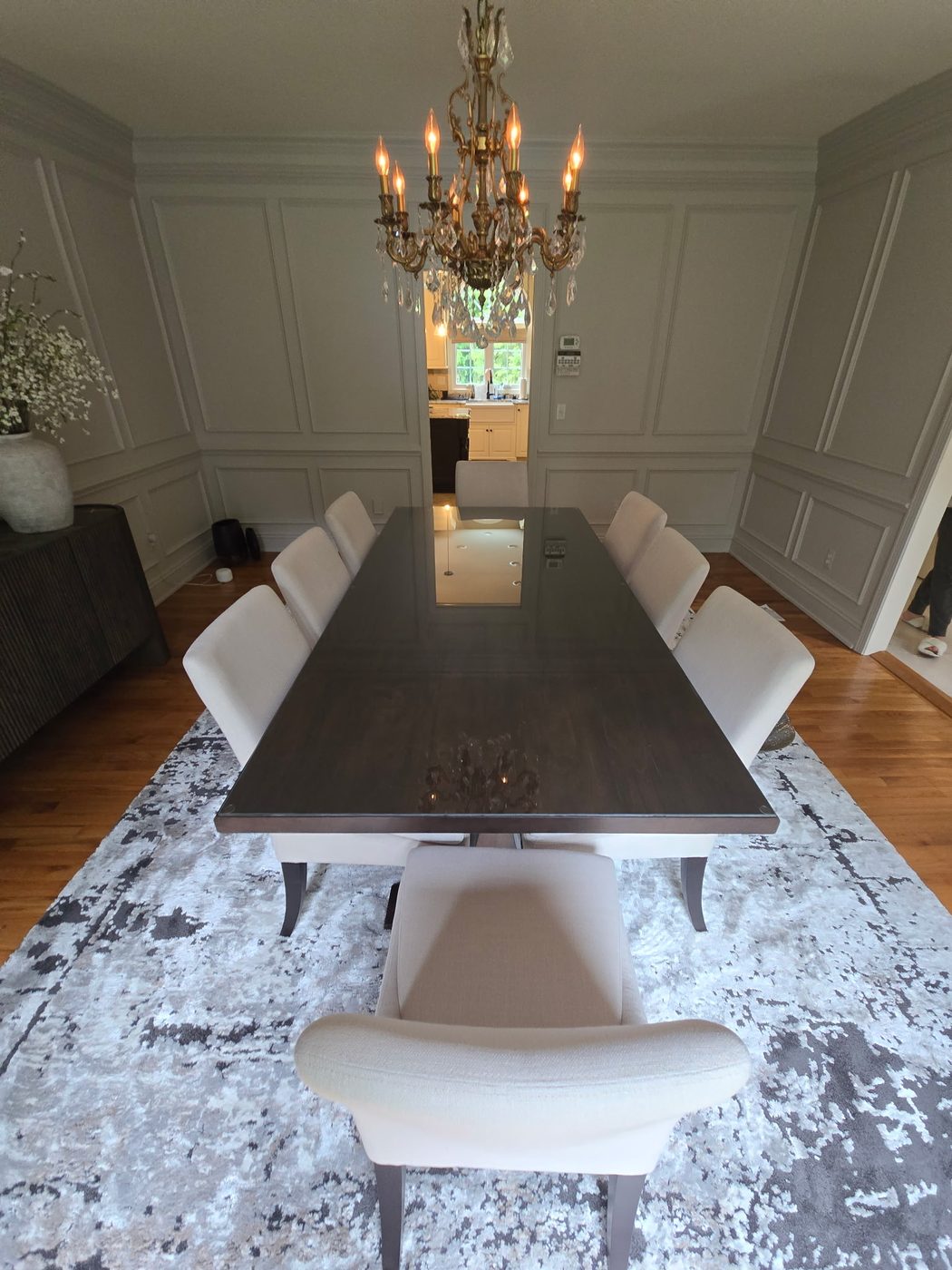
Dining-table tops are larger and more demanding. Standard rectangular dining tables run 60 to 96 inches long by 36 to 48 inches wide; round dining tables run 48 to 72 inches in diameter. Thickness for a freestanding glass dining table is 1/2 inch tempered as the baseline, stepping up to 3/4 inch for very large tables or pedestal bases where the heavier glass adds visible weight. Edges are typically pencil or beveled. Low-iron glass is an upgrade often spec'd on dining tables because it eliminates the faint greenish tint visible at edges on standard clear glass.
Office desks
Glass desktops are a workhorse — the surface is durable, easy to clean, and never shows wear from a keyboard or wrist rest. Standard desk tops run 48 by 24 inches up to 72 by 36 inches. Thickness is 3/8 inch tempered for most home offices, 1/2 inch for executive desks. Drilled holes for cord pass-through can be added (typically a 2-inch grommet location in the rear of the desk) at fabrication. Edge is usually pencil for a clean modern look.
Protective tops over wood
An entirely different category. A protective glass top is a thin (1/4 inch or 5/16 inch) annealed or tempered sheet that sits over an existing solid surface — most often an antique wood dining table, a family heirloom desk, or a high-end wood coffee table the owner wants to protect from drink rings and scratches. The glass acts as a sacrificial layer; the wood underneath stays pristine. Bumper pads keep the glass from sliding and protect the wood finish.
Vanity tops
Less common but a beautiful application. A glass vanity top is a tempered glass surface on a bathroom vanity base, with the sink either vessel-mounted on top or under-mount integrated. Thickness is 1/2 inch or 3/4 inch tempered. The glass is typically frosted or back-painted on the underside for privacy and visual interest, with a polished pencil or flat edge.
Built-in shelving
Glass shelves are a quick win in built-ins, display cases, and bookshelves. Thickness is 1/4 inch or 3/8 inch tempered for most shelf spans up to 36 inches; longer spans need 1/2 inch or a midspan bracket. Edges are pencil or polished flat. We cut shelves to fit existing cabinet openings every week, often as a same-week turnaround.
For our active service offering on tabletops, see our tabletops page.
Tempered vs annealed glass
The first technical decision on any tabletop is whether the glass needs to be tempered or whether annealed is acceptable. The rule is simple, and it's driven by code and by safety:
Tempered glass is required for any tabletop that serves as the primary structural surface of a freestanding piece of furniture — a dining table, a coffee table, a desk, a side table, a conference table, a vanity. The glass is the surface. If it broke, the breakage event would be hazardous, so the glass must be a safety glass that crumbles into small blunt pieces rather than long sharp shards.
Tempered glass is heat-strengthened to roughly four times the impact resistance of annealed (standard) glass. It cannot be cut or drilled after tempering — every edge profile, hole and corner has to be machined into the glass before it goes through the tempering oven. That's why custom tempered tabletops take 2–3 days longer than annealed: the tempering itself is the final step, and the spec has to be locked in before tempering begins.
Annealed (standard) glass is acceptable only for protective top layers laid over an existing solid surface — a glass cover over a wood dining table, a desk pad, a protective layer over an antique. The wood underneath is the structural surface; the glass is just a sacrificial wear layer. If the glass ever broke, the wood is still there, so the safety hazard is much lower.
In practice, the overwhelming majority of glass we cut for tabletop applications is tempered. Annealed is a budget-friendly option for protective tops where the customer is willing to handle the glass carefully and the underlying surface is intact. We default to tempered unless the customer specifically asks for annealed for a protective application.
Thickness guide
Thickness is chosen for the application and the look. Heavier glass feels more substantial, costs more, and weighs significantly more. Here is the practical guide we use on every job:
| Thickness | Typical applications | Feel & look |
|---|---|---|
| 1/4″ (6mm) | Protective tops over solid surfaces, small side tables, glass shelves up to 24″ span | Light, minimal visual weight |
| 3/8″ (10mm) | Coffee tables, smaller dining tables, desks, longer shelves, most cut-to-size tops | Substantial without being heavy — the all-around favorite |
| 1/2″ (12mm) | Larger dining tables, executive desks, conference tables, vanity tops | Premium feel, visible thickness from across the room |
| 3/4″ (19mm) | Very large dining or conference tables, pedestal bases, statement furniture | Dramatic — the glass becomes a design feature |
The most common thickness we cut is 3/8 inch. It hits the sweet spot for nearly every residential tabletop application: substantial enough to feel solid on a slim base, not so heavy that it requires extra mounting hardware or transport care. 1/2 inch is the next step up and is almost always spec'd on dining tables longer than 72 inches.
Weight matters. A 72 by 36 inch dining table top weighs roughly 70 pounds at 3/8 inch and 95 pounds at 1/2 inch. That's a two-person carry — meaningful for delivery and any future moves.
Edge finishes
The edge of the glass is the visible profile around the perimeter. Four standard finishes cover almost every project:
| Edge | Look | Best use case | Cost premium |
|---|---|---|---|
| Pencil | Softly rounded over the top and bottom — like a pencil tip | Modern, transitional, all-around — the safe default | Base — included |
| Polished Flat | Flat front face with the top and bottom corners softened | Modern, architectural, slightly more "engineered" look | +5–10% |
| Beveled | 1/2″ or 1″ chamfered cut at the top edge — faceted | Traditional, formal, dining and conference tables | +15–30% |
| Ogee | Sculpted S-curve profile — substantial decorative edge | Furniture-grade, decorative, premium pieces | +40–80% |
The decision is mostly aesthetic. All four edges are equally durable and equally smooth to the touch. Pencil edge is the most-spec'd in modern North Jersey homes because it disappears visually — the glass reads as a clean plane without an obvious profile. Beveled edge is the most-spec'd on traditional and formal pieces because the chamfered facet catches light and adds a faceted detail.
Bring a sketch or a photo of the base or the room to your measure and we'll suggest an edge that complements the design. If you're matching an existing piece of furniture, we can match the existing edge profile as closely as the glass allows.
Shape options
Glass cuts to almost any shape you can template. The standard shapes are rectangular, round and oval, but custom-traced and CAD-defined shapes are routine.
Rectangular with square corners is the simplest cut. Rectangular with radiused corners (a 1-inch to 6-inch corner radius) is a common ask for coffee tables and desks — the soft corners are safer for high-traffic rooms and read as more contemporary. Round tops are templated from a center-point and a radius; standard residential rounds run 30 to 72 inches in diameter. Oval and racetrack shapes (with straight sides and rounded ends) are common on dining tables.
Custom shapes — irregular polygons, curved edges, traced templates, organic shapes following a wood top — are cut from a template you provide. Acceptable templates include a paper or cardboard tracing you make at home (place butcher paper over the existing surface, trace the edge), a CAD file from a designer, or an existing piece of glass you bring to the shop. Tolerance on a custom-traced shape is typically 1/16 inch around the perimeter.
Holes for hardware (cord pass-through grommets on a desk, bolt holes for mounting hardware on a glass dining table attached to a metal base) are drilled during fabrication on the same shop ticket as the cut. Hole sizes from 1/2 inch to 4 inches are standard.
Size limits & practical maximums
The practical maximums for a single piece of tempered tabletop glass are roughly 60 inches by 130 inches. That covers the vast majority of residential and commercial applications with no seam: dining tables up to 96 inches long, conference tables up to 120 inches long, even very large coffee tables and desks.
Round and oval tops are limited by the cutting and tempering equipment to roughly 72 inches in diameter as a single piece. Most residential round dining tables fall well within that range.
For very large pieces — a 14-foot or 16-foot conference table, an oversized dining table for a large family — the glass is typically built from two or three panels with seams. The seams can be a polished butt joint (the two pieces meet edge-to-edge, sealed with structural silicone) or hardware-connected (stainless steel patch connectors that join the panels visibly, which can be a design feature in commercial work). Seamed tops are heavier per panel, more expensive overall, and require more careful delivery and install — but they're routine for high-end conference rooms and oversized residential dining.
Tip: When you measure a custom tabletop opening, measure in three places on each axis (front, middle, back of the opening) and use the smallest measurement. Furniture frames, especially older pieces, are rarely perfectly square.
Mounting & stability
How the glass top stays in place on the base matters more than most customers realize. Three standard methods:
Suction cups. Small clear suction discs (typically 2 inches in diameter) adhere to the underside of the glass and the top of the base. The cups hold the glass in place against lateral movement without any permanent attachment — the top can be lifted off for cleaning or moving. Four cups are standard for most coffee tables and dining tables. The cups are nearly invisible from above.
Bumper pads. Clear silicone or felt pads (1/2 inch diameter, 1/8 inch thick) placed between the glass and the base. They cushion the glass against the base, prevent scratching, and provide enough lateral grip for most applications. Lower friction than suction cups, so used when the top doesn't need to resist much lateral force — protective tops over wood, glass shelves in built-ins, light-use tables.
Drilled and bolted. For furniture that needs the glass permanently attached — a glass dining table integrated with a metal base, a desk that ships as one unit — the glass is drilled at fabrication and bolted to the base through threaded inserts or pass-through hardware. Drilled glass adds a fabrication step and adds cost (roughly $30–$50 per hole), but produces a single rigid unit.
The right choice depends on use case and whether the top ever needs to come off. For a freestanding dining table the family might want to reposition over the years, suction cups are the right call. For an integrated desk that ships as one unit, drilled and bolted makes more sense.
Need a custom glass tabletop?
Bring or send measurements and we'll quote it in writing — most tops are fabricated within 5–10 business days. Delivery available across Bergen, Passaic, Hudson and Essex counties.
Get a Free In-Home MeasureCare & cleaning
Glass tabletops are among the lowest-maintenance furniture surfaces. Tempered glass is non-porous, resistant to most household chemicals, and won't stain or absorb spills. The cleaning routine is short:
- Daily. Microfiber cloth and warm water for fingerprints and dust. For sticky spots, add a drop of dish soap.
- Weekly. Ammonia-free glass cleaner with a clean microfiber for streak-free shine. Spray the cloth (not the glass) to avoid overspray onto wood bases or upholstery.
- Spills. Wipe promptly. Standing water on the edge of the glass for hours can leave faint mineral spots, especially in hard-water North Jersey. A quick wipe prevents it entirely.
- Avoid. Abrasive scrubbers, steel wool, pumice stones, razor scrapers (use warm water and dish soap to soften any stuck-on food first), and harsh solvents like acetone on the surface.
For protective tops over wood, also pay attention to the underside — wipe the underside of the glass and the top of the wood once or twice a year to prevent dust accumulation between the two surfaces.
The two most common service calls we get on older glass tabletops aren't actually about the glass — they're about the bumpers or suction cups. Felt bumpers compress over time and silicone bumpers can yellow with UV; both are quick replacements during a kitchen-table-style visit if the rest of the install is otherwise sound.
Cost factors
Most North Jersey custom glass tabletops fall between $200 and $1,200 fabricated, including the glass, edge finish and any cutouts or drilled holes. The five biggest cost drivers:
| Factor | Impact on price |
|---|---|
| Total square footage | Larger tops scale with material cost; very small tops have a shop minimum |
| Thickness | Each step up (1/4″ → 3/8″ → 1/2″ → 3/4″) adds 30–60% to the material cost |
| Tempering | Adds 30–50% to the base cost and 2–3 days to fabrication |
| Edge finish | Pencil is base; polished flat +5–10%; beveled +15–30%; ogee +40–80% |
| Glass type | Clear is base; low-iron is +30–40% (eliminates greenish edge tint) |
| Shape complexity | Rectangles and rounds are base; custom-traced shapes add template fee |
| Drilled holes | $30–$50 per hole, drilled before tempering |
Typical ballparks:
- Protective top over a 60″ dining table, 1/4″ annealed, pencil edge: $225 – $425
- Coffee table top, 48″×24″ 3/8″ tempered, pencil edge: $300 – $600
- Office desk top, 60″×30″ 3/8″ tempered, polished flat edge, one drilled grommet: $450 – $750
- Round dining table top, 60″ diameter, 1/2″ tempered, pencil edge: $700 – $1,200
- Large dining table top, 96″×42″ 1/2″ tempered, beveled edge: $1,100 – $1,800
- Low-iron 1/2″ dining table, beveled or ogee edge: $1,500 – $3,000+
Delivery is quoted separately and is typically $75–$200 within Bergen and Passaic counties for a top that fits in a standard truck. Very large tops (8+ feet) may require a glass-rack truck and two-person delivery, which adds cost.
Lead time & delivery
Most custom glass tabletops are fabricated within 5–10 business days from approval of the order. The timeline breaks down as:
- Annealed cuts (protective tops, basic shelves): 3–5 business days. Cut, edged, ready for pickup or delivery.
- Tempered cuts (most tabletop applications): 5–10 business days. The cutting and edging is fast; the tempering itself is a 2–3 day add because tempered glass goes through an oven at an outside facility.
- Low-iron, ogee edges, oversized pieces: Add 2–5 business days. Low-iron stock is ordered to job; ogee edges require additional shop time.
- Rush jobs: Sometimes possible. Call ahead with the spec and we'll let you know what's feasible. Rush fees apply.
Delivery within Bergen, Passaic, Hudson and Essex counties is typically scheduled within a few days of fabrication completion, on a route day that lines up with your address. Pickup at the Lodi shop is available for tops that fit in a standard SUV or van. We pack tempered tops with edge protection and corner guards for transport.
For larger pieces, we recommend on-site delivery and placement — the glass arrives, we carry it in, set it on the base, position the suction cups or bumpers, and confirm everything is level before we leave. A 96-inch dining table top is a two-person carry, and walking it up a flight of stairs through a doorway is meaningfully different from getting a pre-cut piece into a vehicle.
Putting it all together
A custom glass tabletop is a handful of decisions: structural or protective (drives whether you need tempering), thickness (1/4″ to 3/4″, with 3/8″ being the all-around default), shape (rectangle, round, oval or custom-traced), edge finish (pencil, polished, beveled or ogee), glass type (clear or low-iron), and mounting (suction cups, bumpers or drilled and bolted). Each one is independent — you can mix and match — and each one has cost and design implications.
The two decisions that matter most for the final look are the thickness (which sets the visual weight of the glass) and the edge finish (which sets the design tone — pencil reads modern, beveled reads traditional). The decision that matters most for the long-term experience is whether the top is tempered — because tempered glass is the only spec safe to use as a freestanding structural surface, and once it's installed you'll forget about it for decades.
Bring your dimensions and the application — or call for an in-home measure if you'd like us to template a base or trace a complex shape — and we'll quote it in writing the same business day.