
The edge of a frameless mirror is the visible profile around the perimeter — the only place where the cut-and-finish work shows. It is also the single decision that most strongly sets the design tone of the mirror. The same 30-by-36 mirror in the same bathroom looks meaningfully different with a polished pencil edge versus a 1-inch beveled edge — one reads as modern architecture, the other reads as classic decor.
This guide covers the four standard edge finishes — pencil, polished flat, beveled and ogee — and walks through what each one looks like, where each one fits best in a North Jersey home, and what each one costs. If you're still deciding between framed and frameless before getting to the edge question, start with our framed vs frameless guide. For broader mirror-wall context, see the complete custom mirror walls guide.
The four standard edge profiles
Almost every custom mirror we cut uses one of four edge finishes. Each one is machined and polished on the shop CNC edger, then hand-inspected for clarity and consistency.
Polished pencil edge
The most-spec'd edge in modern North Jersey homes. The top and bottom corners of the glass are radiused into a smooth curve — the cross-section looks like the tip of a pencil. The result is an edge with no visible angles, no facets, no decorative reveal. The glass appears to terminate cleanly into the wall.
Pencil edge is the default included in nearly every custom mirror quote. It is the cleanest, simplest, most modern-leaning profile, and it works in almost every design context. The edge is comfortable to touch and to handle. For frameless mirrors mounted to the wall, pencil edge is what disappears most thoroughly — you stop noticing the perimeter and the reflection becomes the focal point.
Polished flat edge
A small visual upgrade from pencil. The front and back faces of the glass remain flat (no rounding), and only the top and bottom corners are softened with a small radius. The cross-section is a flat rectangle with chamfered corners.
Flat edge reads as slightly more architectural and slightly more "engineered" than pencil. The flat front face catches more direct light from the side and creates a thin bright line along the perimeter that you can see from certain angles. Designers sometimes prefer flat for very modern bathrooms where they want a touch more visible perimeter than pencil gives — without committing to the decorative weight of a bevel. Costs 5 to 10 percent more than pencil.
Beveled edge
The classic decorative edge. A 1/2-inch or 1-inch chamfered cut is made along the perimeter at the top of the glass, creating a faceted angled surface that meets the front face at an obvious geometric line. The bevel is polished to a high-clarity finish and reads as a deliberate decorative reveal.
Beveled edges catch light. From across the room, the bevel reads as a thin band of brightness around the entire perimeter of the mirror — like the mirror has been given a frame made out of reflected light. The effect is unmistakable: a beveled mirror looks intentional, decorative and finished in a way that a pencil-edge frameless mirror does not.
Standard bevel widths are 1/2 inch and 1 inch. Larger bevels (1.5 inch, 2 inch) are available for statement pieces but read as heavy on anything smaller than 36 by 48. The choice between 1/2 inch and 1 inch is mostly a matter of how prominent you want the reveal to be — 1/2 inch reads as a subtle classic detail, 1 inch reads as a clear traditional decorative element.
Ogee edge
The most decorative edge in the standard catalog. An ogee is a sculpted S-curve profile cut into the front edge of the glass — a soft concave curve flowing into a soft convex curve, forming a substantial three-dimensional decorative reveal. The cross-section looks like a piece of classical molding.
Ogee edges are used on premium furniture-grade pieces — antique-style mirrors, decorative wall mirrors, formal dining-room mirrors and very high-end powder-room installs. The edge is unmistakably ornate and is the most expensive of the four standard profiles to fabricate (40 to 80 percent over pencil base cost). Most homeowners only encounter ogee on heirloom or designer pieces; we cut several a year for upper-end Bergen County projects.
Side-by-side comparison
| Edge | Look | Best use case | Cost vs pencil |
|---|---|---|---|
| Polished pencil | Softly rounded — disappears into the wall | Modern, contemporary, full-wall, gyms, master baths | Base — included |
| Polished flat | Flat front face with softened corners — slight architectural reveal | Modern, architectural — when you want a touch more edge presence than pencil | +5–10% |
| Beveled 1/2″ | Subtle faceted reveal — catches light around perimeter | Traditional, transitional, powder rooms, formal baths | +15–25% |
| Beveled 1″ | Prominent faceted reveal — clearly decorative | Traditional, classic, statement powder rooms, period homes | +20–30% |
| Ogee | Sculpted S-curve profile — substantial decorative reveal | Furniture-grade, antique-style, high-end formal rooms | +40–80% |
Where each edge fits best
The right edge depends on the room, the design vocabulary, the size of the mirror and how prominent you want the mirror itself to be as a visual element. Here is the pattern we see most often in North Jersey homes:
Modern and contemporary baths — polished pencil
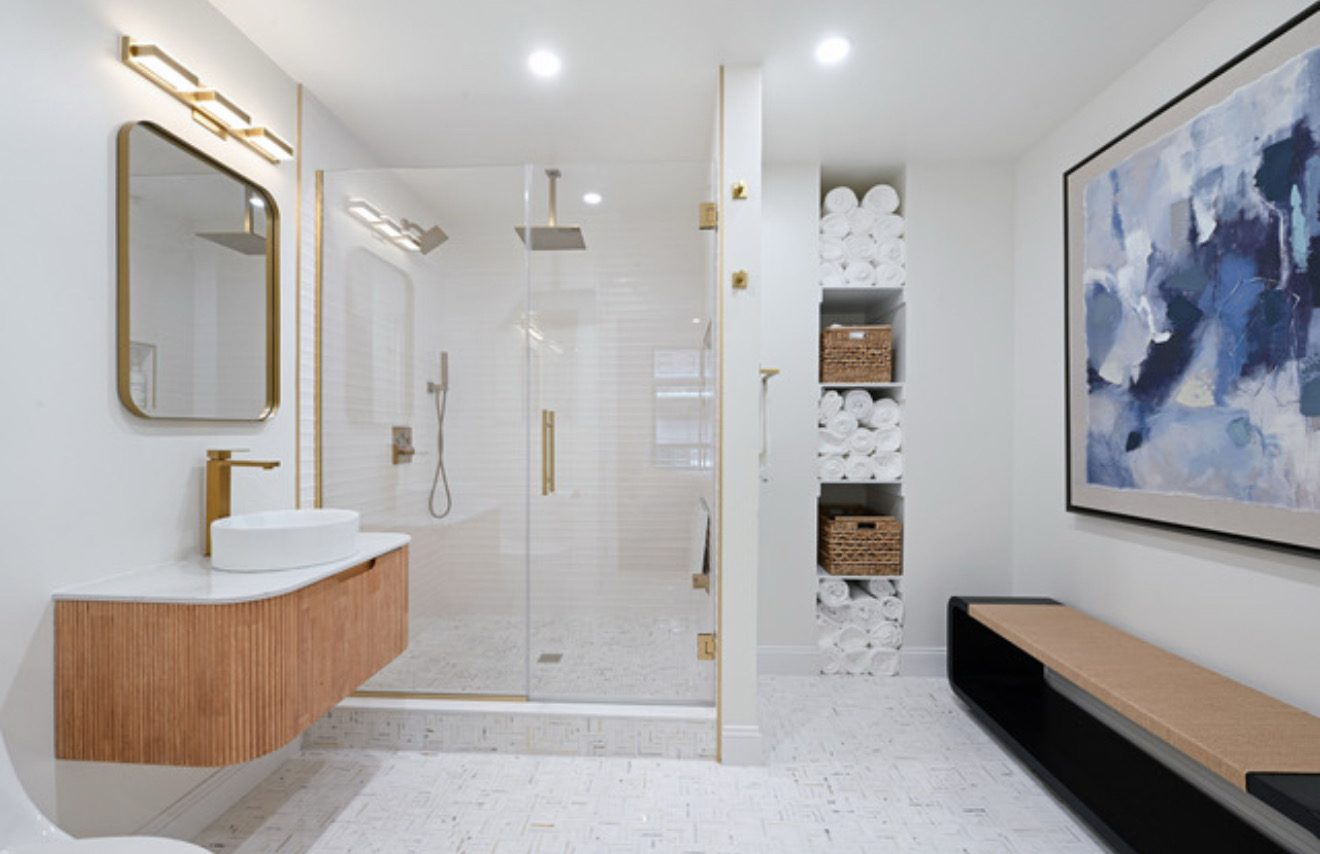
The default for new builds, gut remodels and modern-leaning baths. Pencil edge keeps the mirror visually quiet so the rest of the bath design — tile, plumbing, lighting — can do the work. The mirror reads as a continuous reflective surface rather than a discrete decorative object. Most master baths designed in the last decade in Bergen County use pencil edge.
Traditional and transitional baths — beveled 1/2″
The classic vanity-mirror look. A 1/2-inch beveled edge gives the mirror enough visual presence to anchor a traditional bath without overwhelming it. Pairs well with shaker cabinetry, brushed nickel or brass hardware, and period-leaning tile. Particularly good in transitional baths where the homeowner wants a bit of classic detail without the room feeling fully traditional.
Powder rooms — beveled 1″ or ogee
Powder rooms are the most decorative bath in any house — they get used briefly and looked at often, and the design intent is usually to make a strong visual impression. A 1-inch beveled mirror or an ogee mirror reads as a clear decorative element that contributes to the powder-room theme. We see this combo most often in older Bergen County homes where the powder room has wallpaper, decorative tile or wainscoting.
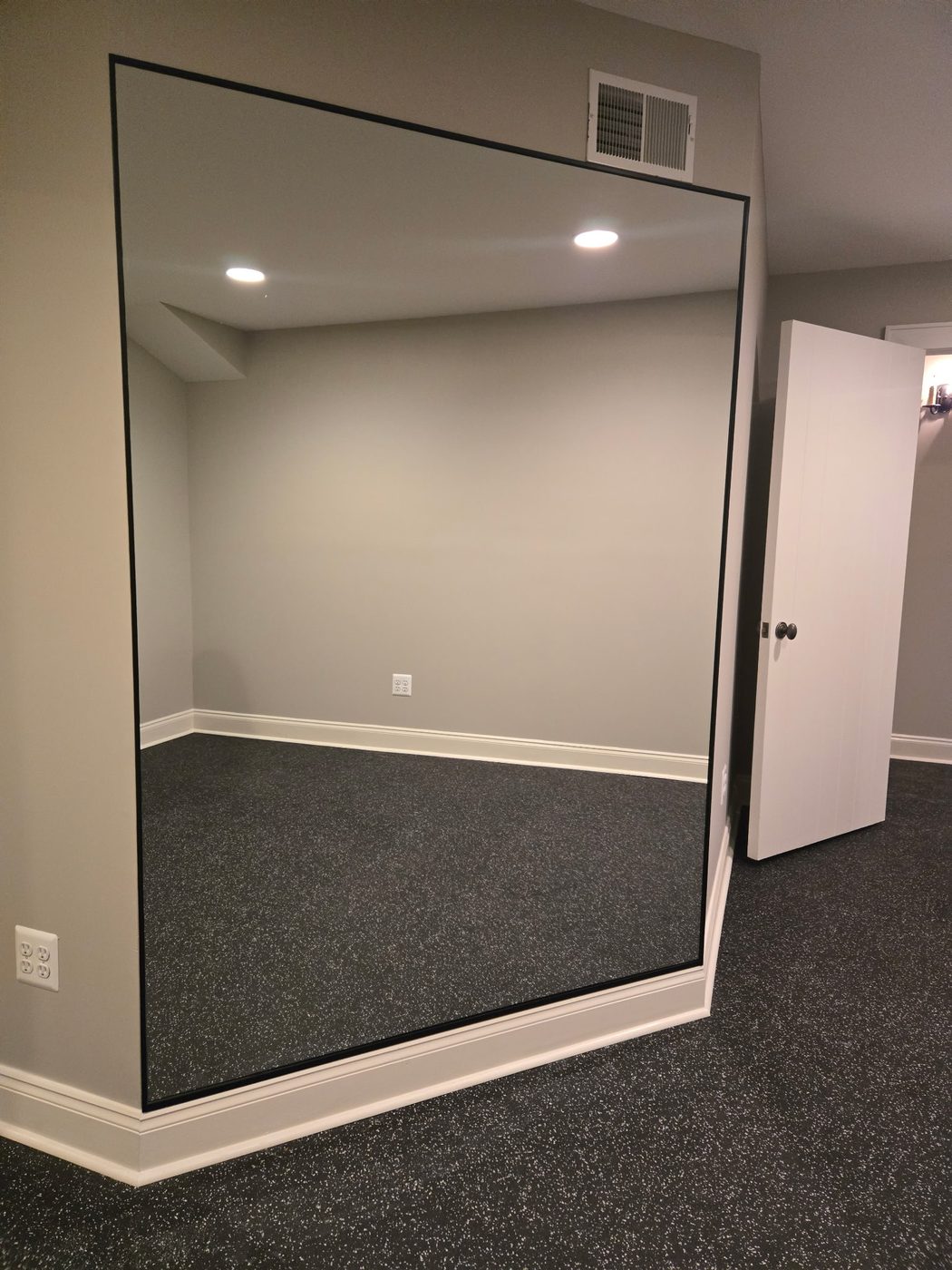
Full-wall and gym mirrors — polished pencil
Pencil edge is the only practical choice for any full-wall install (6 feet wide or larger). A bevel on a full-wall mirror would create a heavy perimeter band that overwhelms the architectural intent of a continuous reflective surface. Pencil edge keeps the mirror clean and quiet — exactly what you want when the mirror itself is meant to function more like a structural surface than a decorative object.
Bedroom and dressing-room mirrors — varies
Free choice. Bedroom and dressing-room mirrors range across the full edge catalog depending on the design intent. A modern dressing area might use pencil; a vintage-inspired bedroom might use beveled. Closet mirrors mounted to the back of a closet door are almost always pencil because the bevel would catch the door frame.
Statement entryway and dining-room mirrors — beveled or ogee
Where the mirror is itself the focal point of the room, ornate edges shine. A large beveled or ogee entry mirror sets the tone for the whole house. A formal dining-room mirror with a substantial bevel reflects chandelier light and contributes to the room's decorative character. These are the projects where edge upgrades earn their cost.
Tip: For a mirror that needs to feel "more than basic frameless" but doesn't quite fit a literal frame, the beveled 1/2-inch edge is the right middle-ground. It is the most-spec'd upgrade we cut. It gives the mirror clear visible presence without the cost or commitment of a custom frame.
Cost in detail
Pricing is driven by edge complexity and the additional shop time required to cut and polish the more complex profile. Most North Jersey custom mirror edge upgrades stay within the $50 to $400 range for a typical vanity-sized mirror, but the percentage premium scales with mirror size.
Cost premium by edge type (on a typical 30″×36″ mirror):
- Polished pencil edge: Base cost — included. ~$180 to $320 for a standard frameless mirror in this size.
- Polished flat edge: +5 to 10 percent over pencil. ~$200 to $350.
- Beveled 1/2-inch: +15 to 25 percent over pencil. ~$220 to $400.
- Beveled 1-inch: +20 to 30 percent over pencil. ~$240 to $420.
- Ogee edge: +40 to 80 percent over pencil. ~$280 to $580.
On larger mirrors the absolute dollar premium grows but the percentage stays roughly the same. A 60-by-36 beveled mirror runs $550 to $850 versus $450 to $750 for the same mirror in pencil — a $100-to-$150 upgrade.
The cost premium reflects machine time and skilled hand-polishing. A pencil edge is one pass through the CNC edger; a beveled edge requires multiple passes and a separate beveling machine; an ogee edge requires hand-finishing on a polishing wheel. The labor difference is real and shows up in the price.
Practical considerations beyond looks
A few practical factors matter alongside the aesthetic decision:
Mirror size and edge proportion. Bevels read best in the 18-to-60-inch range. Below 18 inches the bevel can feel oversized relative to the mirror; above 60 inches the bevel band starts to feel heavy against the larger reflective surface. For full-wall and oversized mirrors, pencil or flat is the right call.
Lighting in the room. Beveled edges catch light, so they shine in well-lit rooms with strong ambient or directional lighting. In a dim space (a windowless powder room with low warm sconces, a basement gym), the bevel still reads as a decorative reveal but doesn't have the same light-catching brilliance. Pencil edges look the same in any lighting.
Mounting method. The edge finish has to be considered alongside the mounting method. A J-channel install hides the bottom edge inside the channel, which means the polished or beveled bottom edge is partially or fully covered. For installs where the entire perimeter is visible (top, bottom and both sides), the edge choice matters everywhere. For installs where the bottom is in a channel, you can sometimes save a few dollars by spec'ing the bottom edge as a basic seam rather than full polish — though most homeowners want the full edge finish "just in case" the channel is ever removed.
Cleaning. All four edge finishes clean the same way with the same routine. There is no maintenance difference between pencil and beveled. Both wipe clean with a microfiber and ammonia-free glass cleaner.
Safety. Edge finish does not affect safety or durability. All four profiles are polished to a smooth finished surface that won't chip under normal use. What affects safety is whether the mirror has safety-film backing — an unrelated upgrade that we recommend on gym mirrors, low-mounted mirrors and high-impact-risk applications. See our custom gym mirrors guide for more on safety film.
Matching existing edges in a remodel
If you're replacing an existing mirror in a remodel and want the new mirror to match the rest of the home's mirror language, bring a photo of the existing mirror (or a sample if you can pull one) to the measure. We can match any of the four standard profiles, and on antique restorations we can replicate older non-standard bevel widths (3/4 inch, 1.25 inch, 1.5 inch) with custom shop time.
For matching across multiple mirrors in a single project — a primary bath, a powder room and an entryway mirror, for example — pick the edge first and commit to it across all the pieces. Mixed edge profiles in the same house read as a design accident; consistent edges across a home read as intentional.
For our active service offering on custom mirrors with every edge profile available, see our mirrors page.
Choosing an edge for your custom mirror?
We bring edge samples to the measure visit so you can see pencil, flat, beveled and ogee in your own light, in your own room — then quote in writing the same week. Delivery and install across Bergen, Passaic, Hudson and Essex counties.
Get a Free In-Home Measure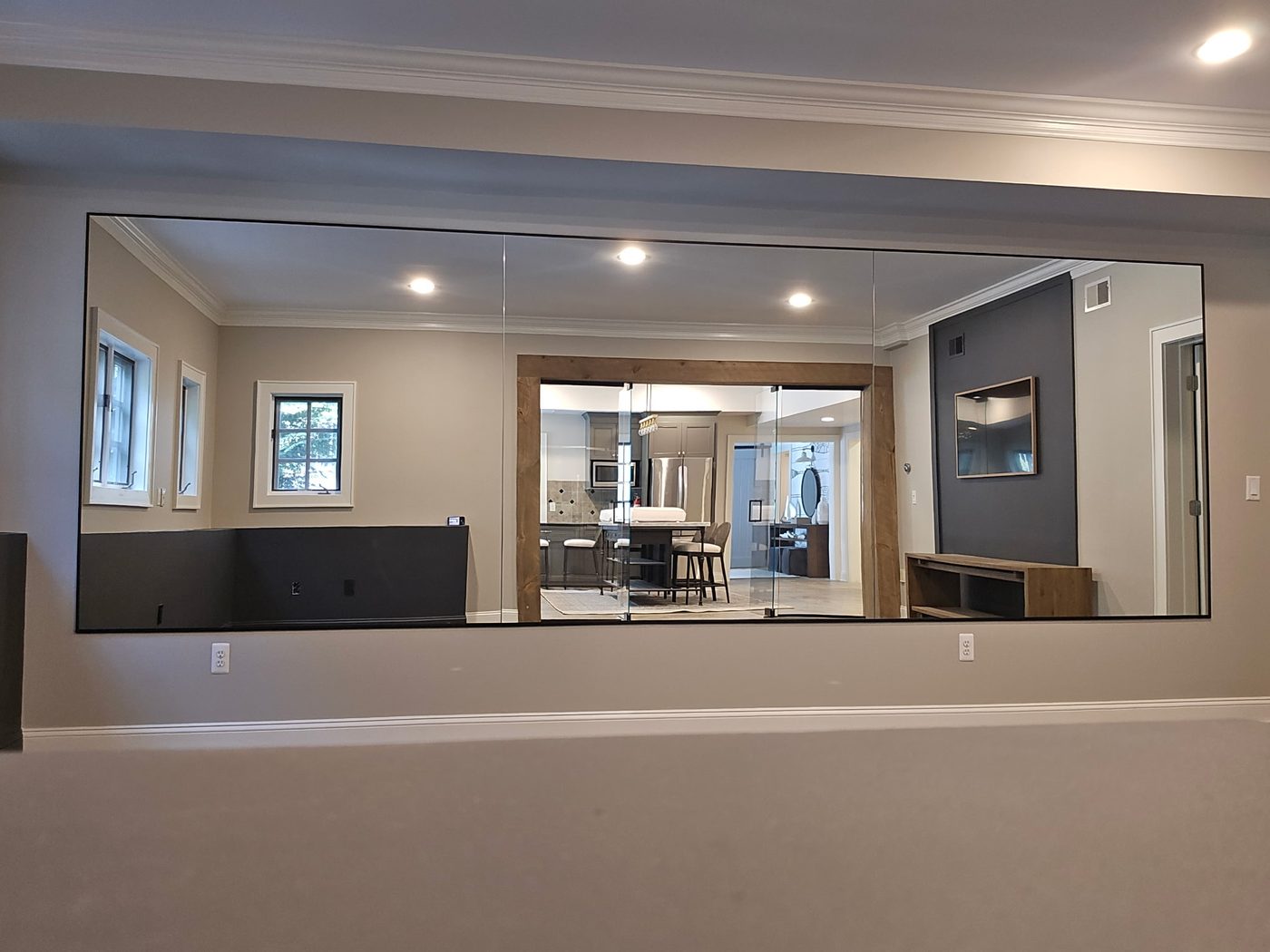
The two edge choices most homeowners actually make
After hundreds of NJ mirror jobs, the pattern is clear: roughly 65 percent of customers choose polished pencil edge and roughly 25 percent choose beveled 1/2 inch. The remaining 10 percent is split among polished flat, beveled 1 inch and ogee for statement pieces.
That distribution mirrors the broader design trend in North Jersey homes — modern and transitional baths default to pencil, traditional and decorative spaces choose beveled. The flat edge is a specialty for design-forward modern installs; ogee is reserved for high-end formal rooms.
If you are unsure, the safest bet is polished pencil. It works in every context, costs nothing extra, and never reads as a design mistake. The upgrade to beveled is the right call when you specifically want the mirror to be a decorative element rather than an invisible reflective surface — and when the room's design vocabulary supports a clear decorative reveal.
Putting it all together
Edge finish is a small decision that makes a meaningful visual difference. The four standard profiles — pencil, flat, beveled and ogee — span the full range from invisible-modern to ornate-traditional, and the cost premium scales with complexity. Pencil disappears, flat hints at architecture, beveled announces decoration, ogee commits fully to ornament.
The most reliable way to choose is to see samples in your actual room. We bring edge samples to every mirror measure visit and let you hold them up to the wall in the light you'll actually live with. Most homeowners decide within a few minutes once they see the difference live. Call to schedule the measure and we'll bring the full set so you can see all four side-by-side.